When I first joined ALLSTARSIT, it was the atmosphere. Today the company has changed, and many of those traditions are gone. What keeps me here now is something different.
First, it's the people. I've built genuine relationships with both Ukrainian and Israeli colleagues, even though we work remotely.
Second, it's the business domain. Our product feels like a private intelligence agency for the maritime industry.
And finally, it's the feeling that both the product and the business keep growing, together with the technologies we use.
For over five years at ALLSTARSIT, Yevhen Batsiun has grown from a Software Engineer into a Team Lead, leading a fully remote team of eight engineers. Along the way, he learned that technical expertise isn't just about writing code – it's about understanding the real problem before solving it.
We spoke with Yevhen about leadership, communication, AI, and why the best solutions always start with the right questions.
Our work comes in waves. Sometimes it's a calm month, and sometimes it's two weeks of intense pressure where the whole team (including the manager) is fully engaged.
What keeps me going is responsibility. When people rely on your work, you naturally want to deliver.
At the same time, I've learned that overtime always has its limits. After a certain point, people become exhausted, frustrated, and much less effective. Sustainable performance matters more than endless hours.
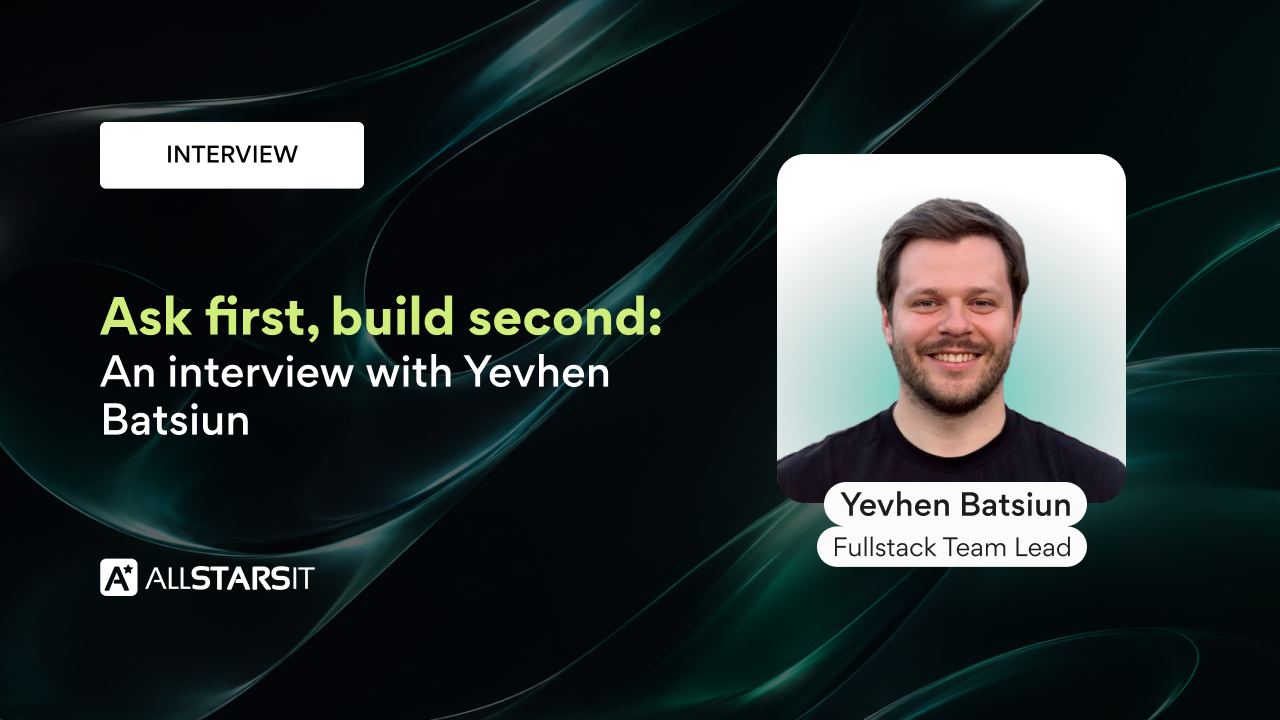
For over five years at ALLSTARSIT, Yevhen Batsiun has grown from a Software Engineer into a Team Lead, leading a fully remote team of eight engineers. Along the way, he learned that technical expertise isn't just about writing code – it's about understanding the real problem before solving it.
We spoke with Yevhen about leadership, communication, AI, and why the best solutions always start with the right questions.
When I first joined ALLSTARSIT, it was the atmosphere. Today the company has changed, and many of those traditions are gone. What keeps me here now is something different.
First, it's the people. I've built genuine relationships with both Ukrainian and Israeli colleagues, even though we work remotely.
Second, it's the business domain. Our product feels like a private intelligence agency for the maritime industry.
And finally, it's the feeling that both the product and the business keep growing, together with the technologies we use.
Our work comes in waves. Sometimes it's a calm month, and sometimes it's two weeks of intense pressure where the whole team (including the manager) is fully engaged.
What keeps me going is responsibility. When people rely on your work, you naturally want to deliver.
At the same time, I've learned that overtime always has its limits. After a certain point, people become exhausted, frustrated, and much less effective. Sustainable performance matters more than endless hours.
One piece of advice completely changed how I approach software development. A developer shouldn't simply implement specifications.
Your job is to understand the real need behind the request, challenge assumptions, and have conversations with Product and Design instead of saying "yes" immediately.
The higher you grow in your career, the less clear your responsibilities become. That's why asking good questions becomes one of the most valuable professional skills.
Mostly through practice. Meetings, discussions, difficult conversations — real situations teach much more than theory. One book that stayed with me is The Five Dysfunctions of a Team by Patrick Lencioni. It's practical and easy to apply.
Working with a psychologist over several years also helped me develop self-awareness – recognizing my emotions, understanding my reactions, and giving myself time instead of responding impulsively.
My manager explained it perfectly from day one: Being a Team Lead isn't a promotion — it's a different career path.
As a developer, you're responsible for your own part of the system. As a Team Lead, you focus on the bigger picture: understanding the team's strengths, identifying risks, balancing workloads, and helping people succeed.
At first, I still wanted to be the strongest engineer on the team. Today, I'm happy that there are people whose technical expertise I fully trust.
One mistake was allowing knowledge to become too isolated. Each engineer owned their own area, which meant vacations or absences created unnecessary risks.
Another lesson was realizing I didn't have to answer every difficult question myself. Now I involve the team in important discussions and invite engineers to meetings whenever possible.
The quality of decisions has improved, and everyone understands the product much better.
Our management challenged us to become ten times more effective with AI. It sounds ambitious, but I believe it's achievable.
Today I build AI agents for repetitive engineering tasks. One of them performs security code reviews. Another helps me after vacations by reading messages, emails, technical updates, and preparing structured summaries. Without that support, it's easy to miss something important.
I believe the future isn't about simply using AI. It's about learning how to orchestrate multiple AI agents to solve complex problems together.
Life in Kyiv during the fifth year of the war, combined with leading a team, can be mentally demanding.
What helps me stay balanced is actually quite simple:
Nothing extraordinary, but it works.
For me, expertise isn't about having all the answers. It's about being able to solve problems of almost any complexity and, even more importantly, asking the right questions before trying to solve them.
It's similar to my old construction experience. A client might say, "I want it to look nice". Your first job isn't to start working. Your first job is to understand what "nice" actually means.
That's where real expertise begins.
For over five years at ALLSTARSIT, Yevhen Batsiun has grown from a Software Engineer into a Team Lead, leading a fully remote team of eight engineers. Along the way, he learned that technical expertise isn't just about writing code – it's about understanding the real problem before solving it.
We spoke with Yevhen about leadership, communication, AI, and why the best solutions always start with the right questions.