
The next generation of high-performance engineering teams combines senior talent with embedded AI agents.
We build teams designed exactly this way.
For years, improving software delivery meant expanding the team. When product demands increased, companies hired more engineers, assuming that greater headcount would naturally translate into greater output. In slower, more predictable markets, this approach was often enough.
Today, market dynamics have changed. Product cycles are shorter, competition is faster, and efficiency is scrutinized as closely as growth. In this environment, increasing team size does not automatically improve delivery.
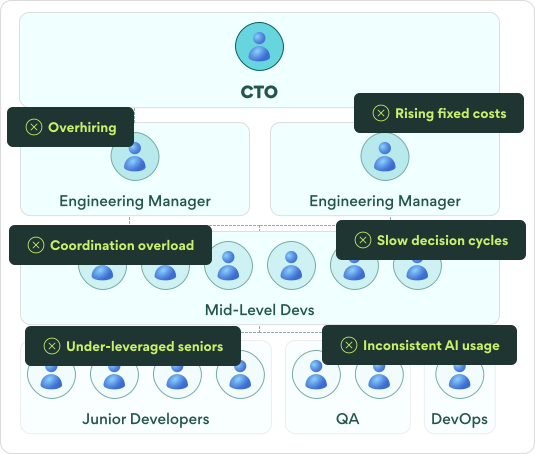
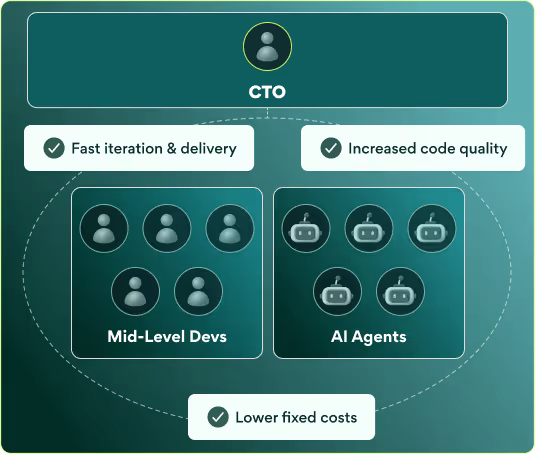
Instead of scaling through volume, leading companies are scaling through seniority and leverage.
Small, senior engineering teams supported by embedded AI agents increase throughput without increasing headcount.
The result is faster delivery, higher code quality, and better cost efficiency.
Traditional scaling model

6–12 engineers to deliver roadmap
Senior engineers spend time mentoring & reviewing
Multiple management and reporting layers
AI tools used inconsistently across developers
More meetings as team grows
AI-augmented software
development teams

3–5 senior engineers supported by AI agents
Senior engineers focus on architecture and complex execution
Flat, senior-led structure with direct ownership
AI embedded into standardized workflows
Reduced coordination overhead

Faster time-to-market
Senior-led execution combined with embedded AI reduces delivery cycles and shortens iteration time.

Higher engineering productivity
AI agents handle repetitive, time-intensive tasks while senior engineers focus on architecture and high-impact decisions.

Lower fixed cost growth
A smaller senior team supported by AI delivers greater output than larger traditional teams, keeping payroll growth controlled.

Improved code quality
AI-assisted testing and review processes increase consistency and reduce defects before production.

Predictable delivery
Clear ownership and reduced coordination overhead create more reliable sprint execution and roadmap forecasting.

Scalable without structural complexity
You gain capacity without introducing additional management layers, excessive meetings, or communication bottlenecks.
Case Study
A Series B SaaS company needed to accelerate its product roadmap ahead of international expansion. The roadmap included major feature releases, infrastructure upgrades, and AI-driven enhancements. However, the internal engineering team was already operating at full capacity.
Initially, leadership considered hiring six to eight additional engineers. However, projected hiring timelines extended several months, and the associated increase in fixed payroll raised concerns about long-term cost efficiency and coordination complexity.
Instead of expanding the existing structure, the company deployed a senior-led AI-augmented software development team designed for end-to-end ownership.
The deployed team included:

1 Lead / Principal Engineer
Responsible for architecture and technical direction

3 Senior Engineers
Aligned with the company’s core product stack

Embedded AI agents
Integrated into coding, testing, documentation, and DevOps workflows
The team operated as a focused delivery unit, collaborating directly with product stakeholders while maintaining clear accountability.

Within weeks of deployment, the team began contributing to high-priority roadmap items. By leveraging senior expertise and structured AI support, the company increased delivery capacity without expanding internal headcount.

Accelerated feature development
Reduced coordination overhead compared to scaling the internal team
Maintained architectural consistency under senior leadership
Controlled fixed cost growth during a critical growth phase
Rather than growing through volume, the company scaled through seniority and AI-enabled execution.

We assess your roadmap, technical landscape, and delivery bottlenecks to define the optimal team structure.

We design a lean, senior-led team built as a structured delivery unit.

We assemble a senior team aligned with your technology stack and delivery goals.

AI agents are embedded into development workflows with standardized, measurable usage.

The team operates with clear sprint cadence and KPIs, adapting as priorities evolve.
Traditional outsourcing is typically centered on providing individual developers to extend an existing team. In contrast, AI-augmented software development teams operate as cohesive, senior-led units with clearly defined ownership and integrated AI support built directly into their workflows. The objective is not to increase headcount, but to increase delivery capacity in a structured and accountable way.
No. In this model, AI enhances senior engineers — it does not replace them. Senior engineers retain full ownership of architecture, technical decisions, and delivery outcomes. AI agents support coding, testing, documentation, and optimization to increase throughput and consistency.
Each team is structured with clearly defined ownership areas, sprint cadence, and performance metrics. Delivery goals are aligned upfront, ensuring transparency and measurable progress throughout the engagement.
Unlike traditional hiring cycles that can take months per role, teams are designed and deployed within weeks, allowing execution to begin significantly faster.
AI integration follows defined usage standards aligned with your security and compliance requirements. AI agents operate within structured workflows to ensure consistency, data protection, and measurable productivity gains.
Yes. The senior-led structure is intentionally designed to integrate with existing product and engineering teams without adding unnecessary hierarchy or coordination overhead.
Design a senior-led, AI-augmented team built for speed, quality, and competitive advantage.
Fill out the form and our team will contact you to discuss your roadmap and define the right structure for your goals.


