Israel has one of the most educated workforces in the world. It also has one of the most competitive hiring markets. For companies trying to scale, those two facts don't cancel each other out but create a paradox that HR teams have to navigate.
The Israeli tech sector has grown faster than the pipeline of qualified talent to support it. Software engineers, data scientists, cybersecurity specialists, and product managers are in chronic short supply. Senior roles can take months to fill, and candidates with in-demand skills often field multiple offers simultaneously. For startups and scale-ups without the brand recognition of a Google or an Intel, winning that competition is an uphill battle.
Years of intense competition for top talent have pushed compensation packages to levels that strain hiring budgets, particularly for early-stage companies. Equity alone no longer seals the deal. Candidates expect strong base salaries, benefits, and flexibility, and the market has largely conditioned them to get it.
Since October 7, 2023, the scale and duration of reserve duty (miluim) has had a measurable impact on workforce availability. Companies have had to plan around prolonged absences, redistribute workloads, and in some cases, delay hiring decisions altogether. This is a planning variable that Israeli employers now build into their workforce strategy.
For many Israeli tech companies, salaries are a shekel problem wearing a dollar mask. Much of the Israeli tech sector operates in US dollars. When the US dollar weakens or the shekel dramatically appreciates, it triggers an immediate operational crisis for tech firms. Because their cash reserves are in dollars but their labor obligations are in shekels, a stronger shekel instantly inflates their local labor costs by roughly 20% in dollar terms.
Together, these pressures have created a hiring environment where finding the right person, at the right cost, at the right time, is harder than it's ever been.
Ask any HR director at an Israeli tech company what keeps them up at night, and the answer is rarely the product roadmap. It's people. Finding them, affording them, and retaining them in one of the world's most competitive talent markets. In 2026, that challenge is pushing companies to rethink hiring from the ground up.
In this article, we break down the key trends defining the market today and what they mean for companies trying to stay ahead.
The pressures are clear. A shrinking local talent pool, salary expectations that keep climbing, and a currency environment that makes every hire more expensive. Together, they're pushing Israeli companies toward a logical question: what if the answer isn't in Israel at all?
It's a question more Israeli companies are asking out loud.
And the answer, increasingly, is international recruitment — not as a fallback, but as a deliberate strategic choice.
The economics alone make the case. A skilled engineer in Eastern Europe, Latin America, or Southeast Asia can cost a fraction of an equivalent hire in Tel Aviv — not because they're less capable, but because their local cost of living is fundamentally different. For a company scaling a team from five to twenty, that gap isn't marginal. It's the difference between an 18-month runway and a 24-month one.
But cost is the floor, not the ceiling. International recruitment, done right, offers access. Access to markets where the talent pipeline is deep, the competition is less ferocious, and the hiring timeline is measured in weeks rather than months. Countries like Poland, Romania, and Portugal have built mature technology ecosystems over the past two decades, with strong engineering cultures and workforces that sit in compatible time zones with Israel. A team split between Tel Aviv and Warsaw is a two-hub operation. More and more Israeli companies are starting to think of it exactly that way.
There's also the question of scale. One of the persistent frustrations of hiring locally is that the talent pool thins out precisely when you need it most. International recruitment breaks that constraint. Finding four strong backend engineers in the next quarter is a realistic goal in Kraków or Medellín. In Tel Aviv, it's a long shot — and an expensive one even if you pull it off.
The companies getting this right are treating international recruitment as the architecture rather than a compromise.
Ask any HR director at an Israeli tech company what keeps them up at night, and the answer is rarely the product roadmap. It's people. Finding them, affording them, and retaining them in one of the world's most competitive talent markets. In 2026, that challenge is pushing companies to rethink hiring from the ground up.
In this article, we break down the key trends defining the market today and what they mean for companies trying to stay ahead.
Israel has one of the most educated workforces in the world. It also has one of the most competitive hiring markets. For companies trying to scale, those two facts don't cancel each other out but create a paradox that HR teams have to navigate.
The Israeli tech sector has grown faster than the pipeline of qualified talent to support it. Software engineers, data scientists, cybersecurity specialists, and product managers are in chronic short supply. Senior roles can take months to fill, and candidates with in-demand skills often field multiple offers simultaneously. For startups and scale-ups without the brand recognition of a Google or an Intel, winning that competition is an uphill battle.
Years of intense competition for top talent have pushed compensation packages to levels that strain hiring budgets, particularly for early-stage companies. Equity alone no longer seals the deal. Candidates expect strong base salaries, benefits, and flexibility, and the market has largely conditioned them to get it.
Since October 7, 2023, the scale and duration of reserve duty (miluim) has had a measurable impact on workforce availability. Companies have had to plan around prolonged absences, redistribute workloads, and in some cases, delay hiring decisions altogether. This is a planning variable that Israeli employers now build into their workforce strategy.
For many Israeli tech companies, salaries are a shekel problem wearing a dollar mask. Much of the Israeli tech sector operates in US dollars. When the US dollar weakens or the shekel dramatically appreciates, it triggers an immediate operational crisis for tech firms. Because their cash reserves are in dollars but their labor obligations are in shekels, a stronger shekel instantly inflates their local labor costs by roughly 20% in dollar terms.
Together, these pressures have created a hiring environment where finding the right person, at the right cost, at the right time, is harder than it's ever been.
The pressures are clear. A shrinking local talent pool, salary expectations that keep climbing, and a currency environment that makes every hire more expensive. Together, they're pushing Israeli companies toward a logical question: what if the answer isn't in Israel at all?
It's a question more Israeli companies are asking out loud.
And the answer, increasingly, is international recruitment — not as a fallback, but as a deliberate strategic choice.
The economics alone make the case. A skilled engineer in Eastern Europe, Latin America, or Southeast Asia can cost a fraction of an equivalent hire in Tel Aviv — not because they're less capable, but because their local cost of living is fundamentally different. For a company scaling a team from five to twenty, that gap isn't marginal. It's the difference between an 18-month runway and a 24-month one.
But cost is the floor, not the ceiling. International recruitment, done right, offers access. Access to markets where the talent pipeline is deep, the competition is less ferocious, and the hiring timeline is measured in weeks rather than months. Countries like Poland, Romania, and Portugal have built mature technology ecosystems over the past two decades, with strong engineering cultures and workforces that sit in compatible time zones with Israel. A team split between Tel Aviv and Warsaw is a two-hub operation. More and more Israeli companies are starting to think of it exactly that way.
There's also the question of scale. One of the persistent frustrations of hiring locally is that the talent pool thins out precisely when you need it most. International recruitment breaks that constraint. Finding four strong backend engineers in the next quarter is a realistic goal in Kraków or Medellín. In Tel Aviv, it's a long shot — and an expensive one even if you pull it off.
The companies getting this right are treating international recruitment as the architecture rather than a compromise.
Not all global hiring markets are equal, and the right destination depends on the role, the budget, and how the team needs to operate. Here's a look at the markets Israeli companies are increasingly turning to, and what each one offers.
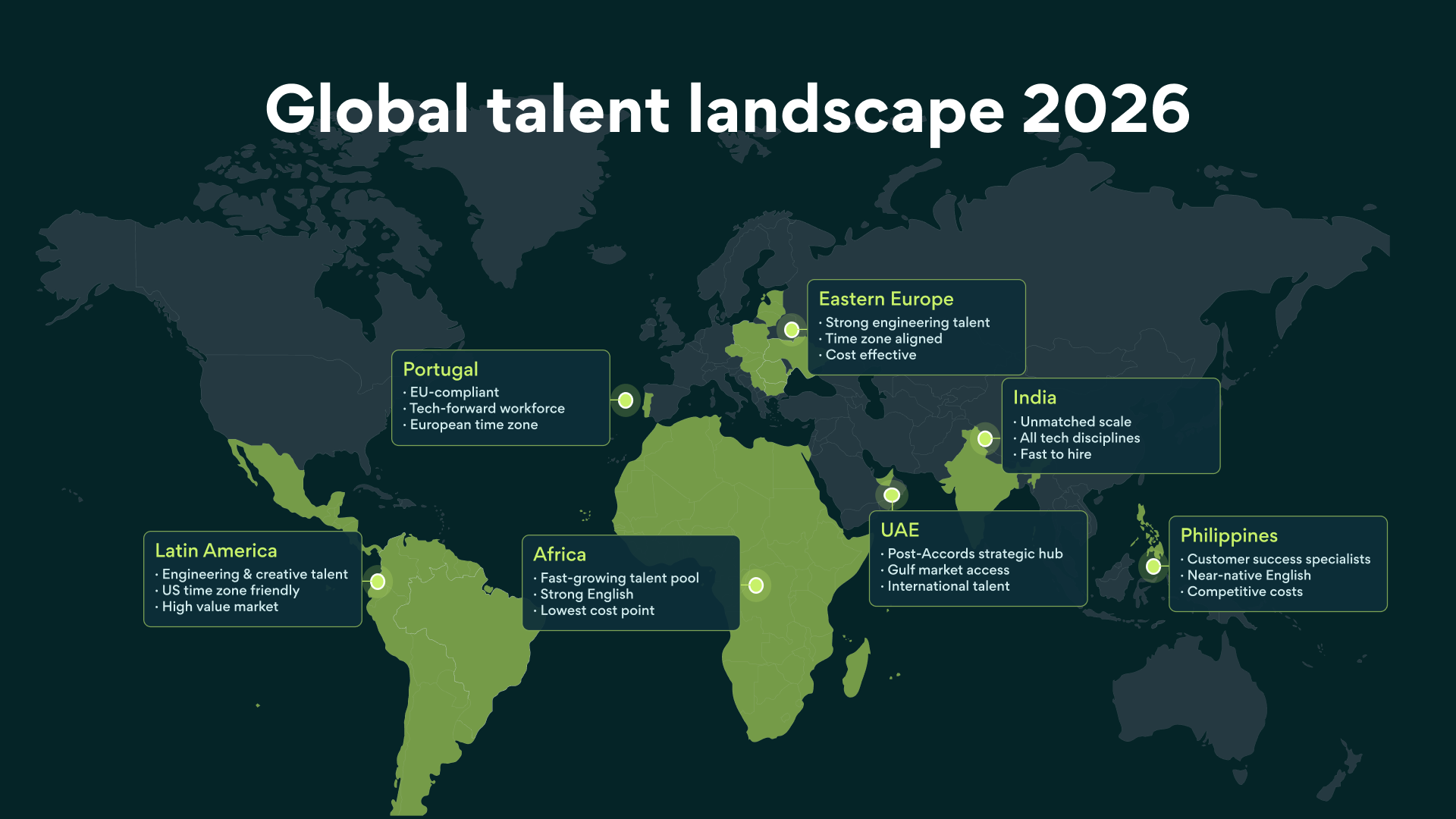
Ukraine, Poland, Romania, and Georgia have long been go-to markets for tech talent — software development, QA, data engineering, and DevOps in particular. Skill levels are high, English proficiency is strong, and the time zone overlap with Israel is comfortable. Cost advantages remain significant relative to local Israeli hiring, even as salaries in the region have risen in recent years.
Portugal has emerged as one of Europe's most attractive hiring destinations, combining EU-compliant employment frameworks with a growing, internationally-minded tech workforce. It's a particularly strong market for companies that need European time zone alignment and the regulatory predictability that comes with hiring inside the EU.
An often-overlooked market with serious potential. Countries like South Africa, Kenya, Egypt, and Nigeria offer a young, fast-growing tech workforce and strong English proficiency. For companies willing to invest in talent development, Africa offers depth at a cost point that's hard to match elsewhere.
Brazil, Colombia, Argentina, and Mexico are producing strong engineering and creative talent, with the added advantage of broader time zone flexibility for companies with US-facing operations. Argentina in particular has become a high-value market, with a highly educated workforce and favorable cost dynamics driven by local economic conditions.
The world's largest talent market for technology roles. India offers unmatched scale across software development, data science, finance, and operations. For Israeli companies looking to build larger teams quickly, India remains one of the most reliable destinations, provided the right management infrastructure is in place.
The UAE is less a cost play and more a strategic one — though the math can surprise you. A large expat workforce makes hiring more manageable than the market's premium reputation suggests. But the real draw is positioning. Since the Abraham Accords, Dubai has become a natural base for Israeli companies with regional ambitions, offering access to Gulf markets and a business culture built around international commerce.
One of the strongest markets globally for customer success, support, and back-office operations. Near-native English proficiency, a service-oriented work culture, and competitive costs make the Philippines a natural fit for Israeli companies scaling customer-facing teams.
Going global sounds straightforward until you're in the middle of it.
Every country comes with its own labor laws, tax obligations, payroll requirements, and employee protections — and what's standard practice in Israel can be a compliance violation somewhere else. Misclassifying an employee as a contractor, missing a mandatory benefit, or getting payroll wrong doesn't just create operational headaches. It creates legal exposure, financial penalties, and the kind of reputational damage that's hard to walk back.
Beyond compliance, there's the operational reality: onboarding people across time zones and cultures, managing retention without local HR knowledge, and navigating currency and payment complexity across multiple markets. The costs of getting this wrong — legal counsel, audits, entity setup, back taxes — often dwarf whatever savings the hire was supposed to deliver.
Luckily, these challenges are navigable. Some companies build the infrastructure in-house over time — developing local HR knowledge, setting up legal entities, learning the hard way. But most find that partnering with a staff augmentation firm is the faster, leaner path — one that lets them focus on building their product while someone else carries the operational and legal weight.
Navigating the global hiring landscape is easier with a partner who already knows the terrain.
ALLSTARSIT specializes in staff augmentation for companies looking to build and scale teams across international markets. Rather than spending months figuring out local employment laws, payroll requirements, and compliance frameworks from scratch, companies work with ALLSTARSIT to source, onboard, and manage talent in the destinations that make the most sense for their business.
For Israeli companies in particular, ALLSTARSIT brings direct experience across the markets covered in this article, from Eastern Europe and Portugal to India and the Philippines. That means vetted talent pipelines, established local infrastructure, and none of the costly trial and error that comes with doing it alone.
The result is a faster path to the global talent your business needs, without the legal and operational risk of building that capability in-house.
Ready to explore what global hiring could look like for your company? Get in touch with ALLSTARSIT.
Ask any HR director at an Israeli tech company what keeps them up at night, and the answer is rarely the product roadmap. It's people. Finding them, affording them, and retaining them in one of the world's most competitive talent markets. In 2026, that challenge is pushing companies to rethink hiring from the ground up.
In this article, we break down the key trends defining the market today and what they mean for companies trying to stay ahead.