Event-driven programming (EDP) is a programming paradigm in which the flow of a program is determined by events (user actions, sensor outputs, messages from other programs, or system-generated triggers) rather than by a fixed, predefined sequence of steps.
Instead of a program executing instructions strictly top to bottom, an event-driven system waits for something to happen, then responds. A button click, a new file uploaded, a payment confirmation, a temperature reading crossing a threshold — each of these can be an "event" that triggers a specific piece of code to run.
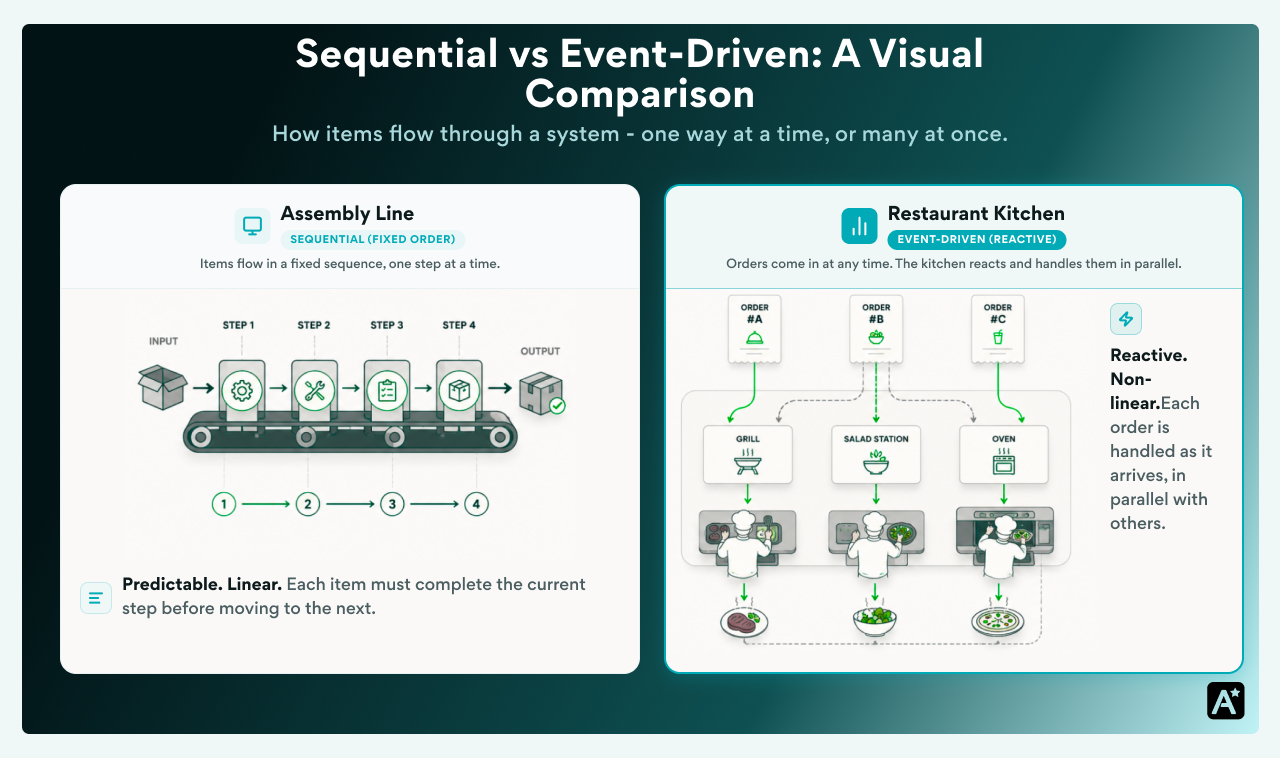
Think of it like a restaurant kitchen instead of an assembly line. An assembly line processes items in a fixed order, one station at a time. A kitchen, by contrast, reacts: an order comes in, a cook responds, a dish goes out — all happening asynchronously and in parallel with other orders. That reactive, non-linear structure is the essence of event-driven programming.
Modern software rarely just sits and waits for one thing to happen at a time. Apps react to clicks, sensors stream data every second, and services talk to each other across the globe without ever pausing to "ask" if something is ready. Much of that responsiveness comes down to one architectural approach: event-driven programming.
Whether you're a developer deciding on an architecture or a business owner trying to understand what your dev team is proposing, this guide breaks down what event-driven programming is, how it works, and when it makes sense to use it.
At a basic level, an event-driven system has three moving parts working together:
Crucially, the program doesn't need to know in advance exactly when an event will occur or in what order multiple events will arrive. It simply stays "listening" and reacts as things happen. This is what allows event-driven systems to handle unpredictable, real-time, or high-volume input without grinding to a halt while waiting for one task to finish before starting the next.
Most implementations rely on an event loop — a continuously running process that checks for new events and dispatches them to the appropriate handler, often without blocking other operations while it waits.
This structure is what gives event-driven systems their main advantages: producers and consumers stay loosely coupled, new listeners can be added without touching existing code, and the system can scale and stay responsive under unpredictable, high-volume input.
The trade-off is that this same flexibility makes the system harder to reason about — tracing a single business process across many asynchronous events, keeping them in the right order, and testing it all end-to-end takes noticeably more effort than following a linear, synchronous call stack.
Modern software rarely just sits and waits for one thing to happen at a time. Apps react to clicks, sensors stream data every second, and services talk to each other across the globe without ever pausing to "ask" if something is ready. Much of that responsiveness comes down to one architectural approach: event-driven programming.
Whether you're a developer deciding on an architecture or a business owner trying to understand what your dev team is proposing, this guide breaks down what event-driven programming is, how it works, and when it makes sense to use it.
Event-driven programming (EDP) is a programming paradigm in which the flow of a program is determined by events (user actions, sensor outputs, messages from other programs, or system-generated triggers) rather than by a fixed, predefined sequence of steps.
Instead of a program executing instructions strictly top to bottom, an event-driven system waits for something to happen, then responds. A button click, a new file uploaded, a payment confirmation, a temperature reading crossing a threshold — each of these can be an "event" that triggers a specific piece of code to run.
Think of it like a restaurant kitchen instead of an assembly line. An assembly line processes items in a fixed order, one station at a time. A kitchen, by contrast, reacts: an order comes in, a cook responds, a dish goes out — all happening asynchronously and in parallel with other orders. That reactive, non-linear structure is the essence of event-driven programming.
At a basic level, an event-driven system has three moving parts working together:
Crucially, the program doesn't need to know in advance exactly when an event will occur or in what order multiple events will arrive. It simply stays "listening" and reacts as things happen. This is what allows event-driven systems to handle unpredictable, real-time, or high-volume input without grinding to a halt while waiting for one task to finish before starting the next.
Most implementations rely on an event loop — a continuously running process that checks for new events and dispatches them to the appropriate handler, often without blocking other operations while it waits.
This structure is what gives event-driven systems their main advantages: producers and consumers stay loosely coupled, new listeners can be added without touching existing code, and the system can scale and stay responsive under unpredictable, high-volume input.
The trade-off is that this same flexibility makes the system harder to reason about — tracing a single business process across many asynchronous events, keeping them in the right order, and testing it all end-to-end takes noticeably more effort than following a linear, synchronous call stack.
A few core building blocks show up across almost every event-driven architecture:
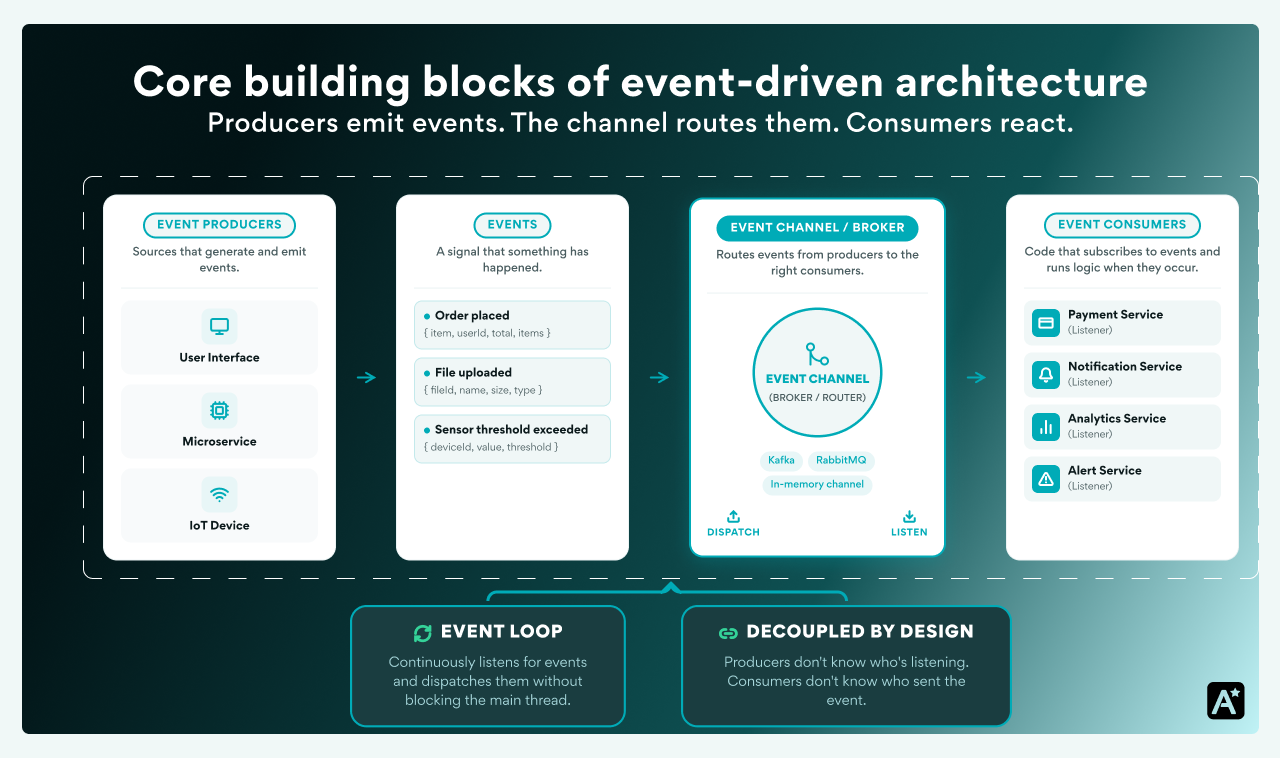
Together, these pieces let producers and consumers stay decoupled — a producer doesn't need to know who's listening, and a consumer doesn't need to know who triggered the event.
The clearest way to understand event-driven programming is to compare it with the more traditional request-driven (synchronous) model.
In request-driven programming, one component directly calls another and waits for a response before continuing — like a phone call where you stay on the line until the other person answers. This is straightforward to reason about but creates tight coupling: if the component being called is slow or down, the caller is stuck waiting too.
In event-driven programming, a component simply announces that something happened and moves on — more like sending a text message. It doesn't wait around for a reply, and it doesn't need to know who, if anyone, is listening. Interested parties react whenever they're ready.
Neither approach is universally "better" — they solve different problems, which is why many real systems use a mix of both.
A few patterns recur across event-driven systems:
Publish/subscribe (pub/sub) — producers publish events to a topic or channel without knowing who's subscribed; any number of consumers can listen and react independently. For example, an e-commerce app might publish an "order placed" event once, and the shipping service, the email service, and the analytics service can all subscribe to it separately — none of them need to know the others exist. This is what makes pub/sub so good for decoupling: you can add a brand-new consumer (say, a fraud-detection service) later without touching the code that publishes the event at all.
Event sourcing — instead of storing just the current state of data, the system stores the full sequence of events that led to that state, making it possible to reconstruct history or replay events. Rather than a bank account table holding just a "balance" field, an event-sourced system would store every "deposit" and "withdrawal" event ever made, and calculate the balance by replaying them. This gives you a complete audit trail for free, makes debugging production issues easier (you can replay exactly what happened), and lets you rebuild state from scratch if something goes wrong — at the cost of more storage and more complex queries.
CQRS (Command Query Responsibility Segregation) — separates the logic that changes data (commands, often event-triggered) from the logic that reads data, which pairs naturally with event-driven and event-sourced systems. Instead of a single model handling both writes and reads, CQRS splits them: a "write model" processes commands and emits events, while a separate "read model" is optimized purely for fast queries and is updated as those events come in. This is especially useful when read and write workloads have very different scaling needs — for instance, a product catalog that's written to rarely but read constantly.
Event streaming — a continuous flow of events is processed in real time (or near real time) rather than handled one-off, common in analytics and monitoring pipelines. Instead of treating each event as an isolated occurrence, streaming platforms like Kafka treat events as an ongoing, ordered log that multiple consumers can read from — at their own pace, and even replay from an earlier point if needed. This pattern is what powers things like live dashboards, fraud detection that reacts within milliseconds, and clickstream analytics across millions of users.
These patterns aren't mutually exclusive — in practice, a single system might use pub/sub for service communication, event sourcing for critical business data like payments, and CQRS to keep reads fast as the system scales.
Depending on scale and use case, teams typically reach for:
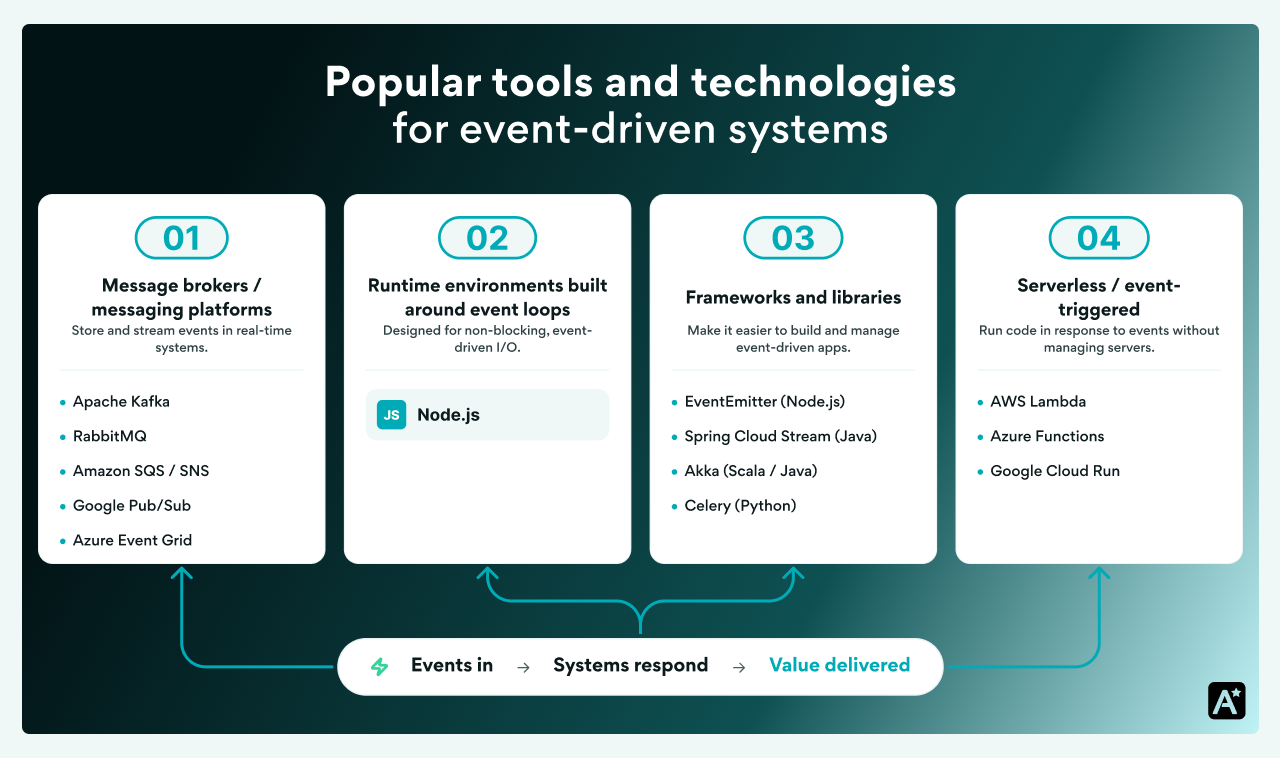
The right tool depends heavily on scale: a single web app might only need an in-process event emitter, while a distributed system handling millions of events per day will likely need a dedicated broker like Kafka.
The patterns and tools covered so far show up in production systems you likely interact with every day. Event-driven programming tends to appear wherever a system can't predict exactly when something will happen, but still needs to respond the moment it does. That could mean a person clicking somewhere on a screen, a device reporting a reading, or one service finishing a task that another service is waiting to hear about. Across industries, a few use cases come up again and again:
Event-driven programming tends to be the right call when:
It's probably overkill when:
A quick way to see the difference in practice: a food delivery platform that needs to update a customer's map in real time as a driver moves is a strong case for event-driven architecture. An internal admin tool used by a handful of employees to update records, on the other hand, gains little from that complexity; a simple, synchronous CRUD API will be faster to build, easier to debug, and just as effective.
For businesses evaluating a new build, this is often a conversation worth having early with your development team — the choice between event-driven and request-driven architecture affects timeline, team composition, and long-term maintenance cost, not just the code itself.
Event-driven programming underpins much of the software we interact with daily, from responsive UIs to the distributed systems powering e-commerce, finance, and IoT. Its core strength — reacting to what happens rather than dictating a fixed sequence — makes it a natural fit for systems that need to scale, stay flexible, and respond in real time.
That flexibility comes with real trade-offs in complexity, though, so it's not automatically the right choice for every project. Understanding both what event-driven programming offers and where it adds overhead is the first step to deciding whether — and how — to build it into your next system.
Modern software rarely just sits and waits for one thing to happen at a time. Apps react to clicks, sensors stream data every second, and services talk to each other across the globe without ever pausing to "ask" if something is ready. Much of that responsiveness comes down to one architectural approach: event-driven programming.
Whether you're a developer deciding on an architecture or a business owner trying to understand what your dev team is proposing, this guide breaks down what event-driven programming is, how it works, and when it makes sense to use it.