Talent acquisition
Anastasiia Chernenka
Read it in:
4 min
Published:
November 2026
Last updated:
November 2026

Most hiring teams already use some automation. An applicant tracking system filters CVs by keyword. A chatbot answers questions on a careers page. These tools follow fixed rules and wait to be told what to do.
An AI agent goes further. Give it a goal, such as "find five senior backend engineers in Poland who know Go", and it plans the steps itself. It searches profiles, ranks candidates, writes personalized messages, follows up and puts interviews in the calendar. It can adjust as it goes, for instance by widening the search if replies are slow.
That autonomy is the selling point. It is also the risk. An agent that acts on its own can make a lot of decisions before anyone checks whether they were the right ones.
Recruitment teams are handing more of their work to AI. Agents now source candidates, read CVs, send messages and book interviews, often without a human touching the process until the final round.
Candidates have noticed. Many now use AI to draft their CVs, write cover letters and apply to dozens of roles in an afternoon. The result is an odd arms race: machines writing applications for other machines to read.
So do AI recruitment agents lead to better hires, or just faster ones? We hire software engineers every day, and our answer is: it depends on what you ask them to do.
In this article, we look at what these agents do well, where they fall short, what the EU AI Act asks of companies that use them and how to get the balance right.
Let's be fair to the technology. For a lot of hiring work, AI agents are quicker and more consistent than people.
Sourcing at scale. An agent can scan thousands of profiles across LinkedIn, GitHub and job boards in minutes. A recruiter would need days. For niche skills, that wider net matters.
First-pass screening. When a job ad draws 400 applications, an agent can sort out the clear mismatches: wrong location, missing must-have skills, no right to work. That frees recruiters to spend time on the candidates who might fit.
Scheduling and follow-ups. Booking interviews across time zones is tedious. Agents do it well, and they never forget to send a reminder or a status update.
Keeping candidates informed. Many applicants never hear back. An agent can make sure everyone gets a timely reply, even if it is a polite no.
Consider a typical case. A client needs three React developers within a month. An agent can build a long list overnight, filter it and book screening calls for the following week. The recruiter starts Monday with a full calendar instead of an empty spreadsheet. That is a real gain.
Recruitment teams are handing more of their work to AI. Agents now source candidates, read CVs, send messages and book interviews, often without a human touching the process until the final round.
Candidates have noticed. Many now use AI to draft their CVs, write cover letters and apply to dozens of roles in an afternoon. The result is an odd arms race: machines writing applications for other machines to read.
So do AI recruitment agents lead to better hires, or just faster ones? We hire software engineers every day, and our answer is: it depends on what you ask them to do.
In this article, we look at what these agents do well, where they fall short, what the EU AI Act asks of companies that use them and how to get the balance right.
Most hiring teams already use some automation. An applicant tracking system filters CVs by keyword. A chatbot answers questions on a careers page. These tools follow fixed rules and wait to be told what to do.
An AI agent goes further. Give it a goal, such as "find five senior backend engineers in Poland who know Go", and it plans the steps itself. It searches profiles, ranks candidates, writes personalized messages, follows up and puts interviews in the calendar. It can adjust as it goes, for instance by widening the search if replies are slow.
That autonomy is the selling point. It is also the risk. An agent that acts on its own can make a lot of decisions before anyone checks whether they were the right ones.
Let's be fair to the technology. For a lot of hiring work, AI agents are quicker and more consistent than people.
Sourcing at scale. An agent can scan thousands of profiles across LinkedIn, GitHub and job boards in minutes. A recruiter would need days. For niche skills, that wider net matters.
First-pass screening. When a job ad draws 400 applications, an agent can sort out the clear mismatches: wrong location, missing must-have skills, no right to work. That frees recruiters to spend time on the candidates who might fit.
Scheduling and follow-ups. Booking interviews across time zones is tedious. Agents do it well, and they never forget to send a reminder or a status update.
Keeping candidates informed. Many applicants never hear back. An agent can make sure everyone gets a timely reply, even if it is a polite no.
Consider a typical case. A client needs three React developers within a month. An agent can build a long list overnight, filter it and book screening calls for the following week. The recruiter starts Monday with a full calendar instead of an empty spreadsheet. That is a real gain.
Speed is not the same as judgment. In tech hiring, the gaps show up quickly.
They mistake keywords for seniority. A CV that lists Kubernetes, microservices and system design looks senior to a machine. But seniority is about decisions: what someone chose not to build, how they handled an outage, when they pushed back on a bad plan. That rarely shows up in a keyword match. Experienced recruiters and engineers spot it in a 20-minute conversation.
They struggle with AI-polished applications. When candidates use AI to write CVs, every application starts to sound the same. Agents tend to reward the most polished, most keyword-rich version. That is not always the best engineer. Sometimes it is just the best prompt.
They filter out unusual talent. Agents learn from patterns, so they favor familiar ones. A self-taught developer, a career changer or someone returning from a career break may never reach a human. Yet some of the strongest engineers we have placed would have failed a strict automated filter.
They cannot judge team fit. Will this person thrive in a small startup or a large bank? Can they explain a technical trade-off to a product manager? Will they ask for help when stuck? These questions decide whether a hire works out, and they need human conversation.
They can put off the best candidates. Strong developers have options. Many receive several messages a week. A generic AI-written message, or a process with no human contact until the final round, signals that the company does not value their time. They simply move on.
None of this means agents are useless. It means they should not be making the decisions that matter most.
The EU AI Act is the European Union's law on artificial intelligence, and the first comprehensive AI law anywhere in the world. It covers any company that uses AI in the EU or sells AI tools there, including businesses based outside Europe. It sorts AI systems by risk: the more harm a system could do to people, the stricter the rules it must follow.
Recruitment sits near the top of that scale. AI that sources, screens, ranks or evaluates candidates is classed as "high-risk", alongside AI used in credit scoring or critical infrastructure. The reasoning is simple: hiring decisions shape people's livelihoods, and a biased algorithm can quietly shut out whole groups of applicants.
In practice, companies that use AI agents in hiring will need to:
Tool providers carry heavier duties, including risk management, data quality checks and technical documentation. But the company using the tool cannot simply blame the vendor. If an agent rejects candidates unfairly, the employer is still on the hook.
When does this apply? Some rules are already in force. Since February 2025, AI that infers people's emotions at work has been banned, which rules out "emotion analysis" in video interviews. The main high-risk obligations apply from December 2, 2027. They were originally due in August 2026, but the EU's Digital Omnibus on AI, which came into force in July 2026, pushed them back.
That is a delay, not a reprieve. If you are adopting AI agents now, build human oversight in from day one. Retrofitting it in 2027 will be harder.
The best results come from dividing the work sensibly. A simple rule: let agentic AI in recruitment handle volume, and let people handle judgment.
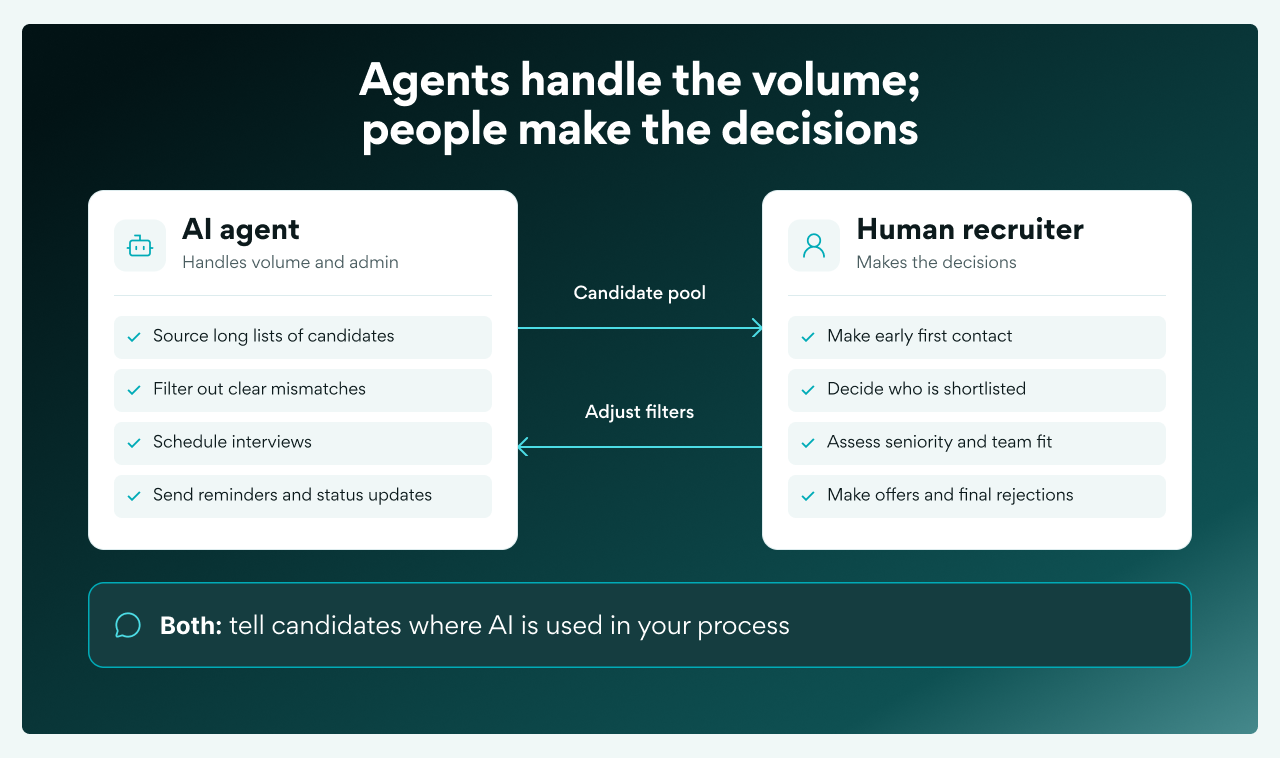
Give agents the admin. Sourcing long lists, filtering out clear mismatches, scheduling and status updates are all good ideas for automation.
Keep humans on the decisions. Who gets shortlisted, who gets an offer and who gets rejected after an interview should be decided by people who understand the role and the team.
Check what the agent filters out. Regularly review a sample of rejected candidates. If good people keep landing in the "no" pile, adjust the criteria.
Be open with candidates. Tell them where AI is used in your process. It builds trust, and from December 2027 it will be required anyway.
Make the first human contact early. Top developers respond to people, not templates. A short call with a recruiter who knows the tech stack does more than ten automated messages.
That last point is where many companies get stuck. A recruiter who can hold their own with a senior engineer is hard to find, and harder to train. That is the gap ALLSTARSIT fills. We let technology speed up the search, while recruiters who understand software engineering, and often engineers themselves, assess every candidate we put forward. Your shortlist arrives faster, and every name on it has been checked by a person who knows what good looks like.
AI recruitment agents are here to stay, and they make hiring faster. But faster is not the same as better. Agentic AI in recruitment can help find a hundred developers who look right on paper. It still takes a person to find the one who is right for your team.
If you need to hire software engineers and want speed without losing judgment, talk to ALLSTARSIT. We combine smart tools with recruiters who know tech, so you meet the right people sooner.
Recruitment teams are handing more of their work to AI. Agents now source candidates, read CVs, send messages and book interviews, often without a human touching the process until the final round.
Candidates have noticed. Many now use AI to draft their CVs, write cover letters and apply to dozens of roles in an afternoon. The result is an odd arms race: machines writing applications for other machines to read.
So do AI recruitment agents lead to better hires, or just faster ones? We hire software engineers every day, and our answer is: it depends on what you ask them to do.
In this article, we look at what these agents do well, where they fall short, what the EU AI Act asks of companies that use them and how to get the balance right.


