
When choosing a cloud provider, it’s important to look beyond brand recognition and dive into the criteria that will actually impact your day-to-day operations. While AWS, Azure, and Google Cloud each offer powerful capabilities, they differ in ways that may or may not align with your business needs. Here are the key factors to evaluate before making a decision:
Reliability is the foundation of every cloud partnership, yet it’s often overlooked until something goes wrong. A provider’s uptime record isn’t just a marketing stat. It dictates how often your services stay available. Companies that don’t examine outage history or redundancy options often discover the consequences at the worst possible moment. Picture a business launching a new product feature, only to have their entire application stall because the single region they chose went down. Customers can’t log in, transactions fail, and the team scrambles to diagnose an issue that was never in their control. When your cloud provider falters, your brand is the one users blame.
Performance issues creep in quietly, and by the time you notice them, the damage may already be done. Businesses sometimes assume that the cloud is universally fast, no matter where users are located. But a platform with limited regional presence can slow everything down for customers on the other side of the world. Imagine a company based in London hosting its application in a U.S. region because it “seemed fine.” For European users, things run smoothly, but their customers in Southeast Asia wait seconds for pages to load, leading to abandoned sessions and frustrated feedback. The right provider doesn’t just run your workloads; it brings them close to the people who use them.
Security becomes a storyline of urgency when it’s addressed too late. Every provider offers a different mix of tools, controls, and certifications. Choosing without considering your specific compliance needs can lead to serious challenges down the road. A healthcare startup might build an MVP quickly, only to realize months later that their chosen provider doesn’t support critical health data regulations. Suddenly, they’re facing a stressful race to migrate systems, rewrite infrastructure, and update processes—steps that could have been avoided with early due diligence. Cloud security isn’t just about protection; it’s about enabling your business to operate confidently within legal and industry boundaries.
Cloud pricing feels simple in theory (pay for what you use) but in practice, it’s full of nuance. Teams often pick a provider based on a few headline costs, only to find hidden fees accumulating over time. A company may choose inexpensive storage thinking they’ve saved money, only to discover that retrieving or transferring that data costs far more. Others run into surprising network charges or discover that their workloads don’t qualify for the discounts they expected. When pricing isn’t evaluated holistically, the cloud can shift from a strategic advantage to an unpredictable expense that erodes budgets as the business grows.
A cloud provider’s ecosystem determines how quickly your teams can innovate. Developers thrive when the platform offers robust integrations, managed services, and powerful tools. But when those elements are missing, progress slows dramatically. Consider a product team relying heavily on machine learning. Choosing a provider with limited ML capabilities means they’ll spend weeks building their own pipelines and infrastructure—time that could have gone toward refining features and improving the product. The ecosystem you choose shapes the pace of your innovation more than most teams realize at the start.
Growth exposes the strengths and weaknesses of your cloud provider. Systems that run smoothly with small user bases may buckle when demand surges. Companies sometimes assume automatic scalability will solve everything, but some platforms have limits or require complex configuration before scaling gracefully. A business that suddenly gains viral attention may watch its app freeze under traffic spikes simply because the underlying architecture couldn’t keep up. Cloud scalability isn’t just about handling more users; it’s about ensuring your infrastructure grows with you, without chaos or rewrites.
Support becomes the hero (or the villain) when something breaks. Teams relying on a provider with limited support often find themselves searching forums, digging through unhelpful documentation, and trying to reverse-engineer issues while customers wait impatiently. In contrast, providers with strong documentation and responsive support can help teams overcome roadblocks quickly and confidently. When troubleshooting stretches from minutes into hours, the cost isn’t just technical—it’s emotional, financial, and reputational. Good support doesn’t just solve problems; it helps prevent crises.
Cloud outages have become an unavoidable reality even for the world’s largest providers. In recent years, disruptions at AWS, Azure, and Google Cloud have taken down major apps and reminded everyone that no cloud is infallible. For organizations depending on 24/7 uptime, these incidents are a wake-up call.
That’s why choosing the right cloud provider isn’t just a matter of pricing or performance. It’s about understanding the strengths and trade-offs of each platform. With AWS, Azure, and Google Cloud all competing to offer the best mix of features it’s easy to make a decision based on marketing rather than strategy
This guide breaks down what truly matters. From outage history to infrastructure design to key capabilities, you’ll get a clear and practical comparison to help you choose the cloud provider that aligns with your goals and risk tolerance in 2026.
The three major cloud providers (AWS, Azure, and Google Cloud) each bring their own history, strengths, and philosophies to the table. Understanding these differences is the first step toward choosing the right fit. AWS is the veteran of the group, the platform that essentially defined what modern cloud computing looks like. It grew out of Amazon’s need to scale its own massive operations, and that DNA shows. AWS offers the broadest range of services, the most mature ecosystem, and a depth of features that can feel almost limitless. For some businesses, that’s incredibly empowering. For others, the sheer complexity can feel overwhelming, like walking into a hardware store with a thousand tools when you only need three.
Azure arrived with a different advantage: Microsoft’s long-standing relationship with enterprises. Companies already built on Windows Server, SQL Server, and Active Directory found Azure to be a natural extension of their existing infrastructure. This familiarity helped Microsoft position Azure as the cloud for organizations with deep roots in traditional IT. Over time, it has evolved into a powerful platform that blends hybrid cloud, enterprise management tools, and strong integrations with products many businesses already use every day. Its story isn’t just about cloud innovation. It’s also about meeting companies where they already are.
Google Cloud, meanwhile, comes from a world built on search, data, and global-scale engineering. Its strengths reflect that heritage. Google’s cloud offerings lean heavily into data analytics, machine learning, and high-performance computing, backed by the same infrastructure that powers products like YouTube and Google Search. For teams focused on big data, AI, or pushing the limits of performance Google Cloud often feels like the most forward-looking option. But because its enterprise adoption came later than AWS or Azure, some organizations find its ecosystem smaller or its enterprise tooling less familiar.
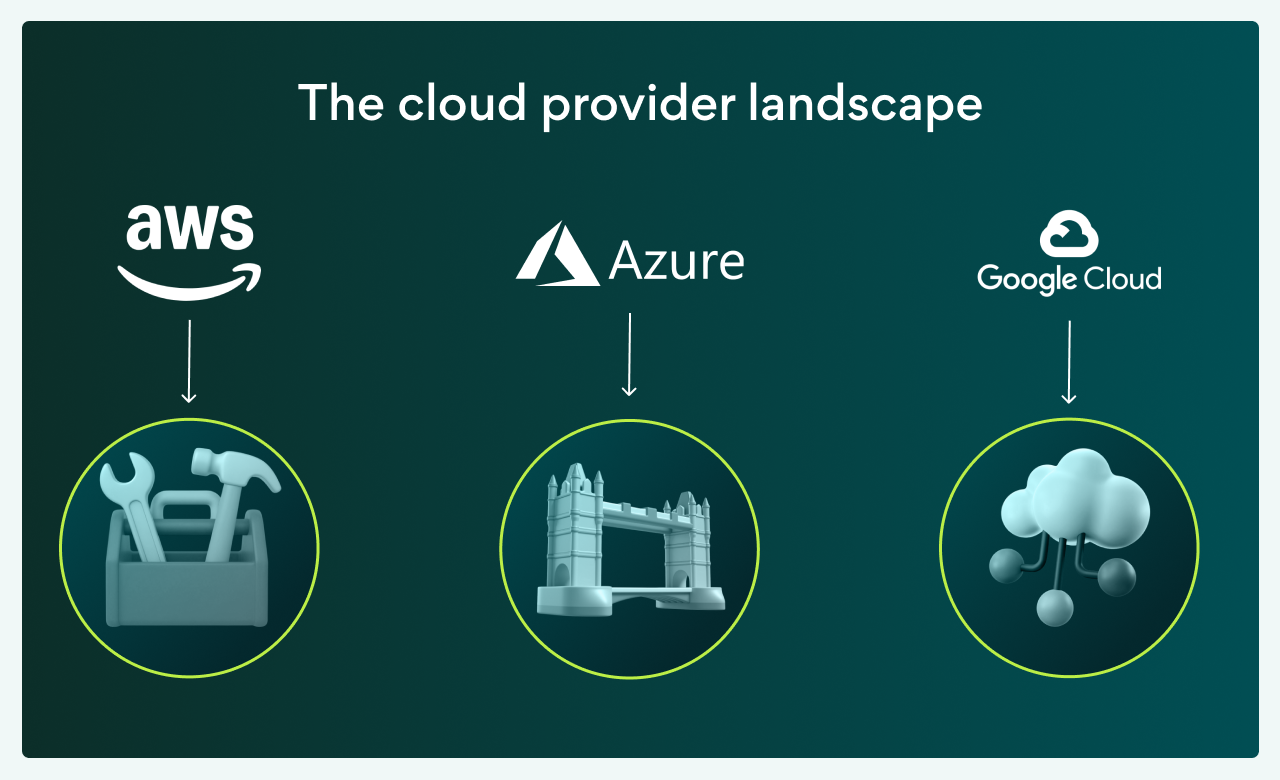
Together, these three platforms represent different visions of what the cloud can be: AWS as the all-encompassing builder’s toolbox, Azure as the enterprise-friendly bridge between old and new, and Google Cloud as the innovator built for data-driven futures. Each one can power a modern business at scale, but the experience you’ll have depends entirely on which path aligns most closely with your goals, your team, and the story you want your technology to support.
When it comes to choosing the right cloud provider, the real differences start to show in their features, capabilities, and pricing models, each shaping how efficiently your business can operate and scale.
Cloud outages have become an unavoidable reality even for the world’s largest providers. In recent years, disruptions at AWS, Azure, and Google Cloud have taken down major apps and reminded everyone that no cloud is infallible. For organizations depending on 24/7 uptime, these incidents are a wake-up call.
That’s why choosing the right cloud provider isn’t just a matter of pricing or performance. It’s about understanding the strengths and trade-offs of each platform. With AWS, Azure, and Google Cloud all competing to offer the best mix of features it’s easy to make a decision based on marketing rather than strategy
This guide breaks down what truly matters. From outage history to infrastructure design to key capabilities, you’ll get a clear and practical comparison to help you choose the cloud provider that aligns with your goals and risk tolerance in 2026.
When choosing a cloud provider, it’s important to look beyond brand recognition and dive into the criteria that will actually impact your day-to-day operations. While AWS, Azure, and Google Cloud each offer powerful capabilities, they differ in ways that may or may not align with your business needs. Here are the key factors to evaluate before making a decision:
Reliability is the foundation of every cloud partnership, yet it’s often overlooked until something goes wrong. A provider’s uptime record isn’t just a marketing stat. It dictates how often your services stay available. Companies that don’t examine outage history or redundancy options often discover the consequences at the worst possible moment. Picture a business launching a new product feature, only to have their entire application stall because the single region they chose went down. Customers can’t log in, transactions fail, and the team scrambles to diagnose an issue that was never in their control. When your cloud provider falters, your brand is the one users blame.
Performance issues creep in quietly, and by the time you notice them, the damage may already be done. Businesses sometimes assume that the cloud is universally fast, no matter where users are located. But a platform with limited regional presence can slow everything down for customers on the other side of the world. Imagine a company based in London hosting its application in a U.S. region because it “seemed fine.” For European users, things run smoothly, but their customers in Southeast Asia wait seconds for pages to load, leading to abandoned sessions and frustrated feedback. The right provider doesn’t just run your workloads; it brings them close to the people who use them.
Security becomes a storyline of urgency when it’s addressed too late. Every provider offers a different mix of tools, controls, and certifications. Choosing without considering your specific compliance needs can lead to serious challenges down the road. A healthcare startup might build an MVP quickly, only to realize months later that their chosen provider doesn’t support critical health data regulations. Suddenly, they’re facing a stressful race to migrate systems, rewrite infrastructure, and update processes—steps that could have been avoided with early due diligence. Cloud security isn’t just about protection; it’s about enabling your business to operate confidently within legal and industry boundaries.
Cloud pricing feels simple in theory (pay for what you use) but in practice, it’s full of nuance. Teams often pick a provider based on a few headline costs, only to find hidden fees accumulating over time. A company may choose inexpensive storage thinking they’ve saved money, only to discover that retrieving or transferring that data costs far more. Others run into surprising network charges or discover that their workloads don’t qualify for the discounts they expected. When pricing isn’t evaluated holistically, the cloud can shift from a strategic advantage to an unpredictable expense that erodes budgets as the business grows.
A cloud provider’s ecosystem determines how quickly your teams can innovate. Developers thrive when the platform offers robust integrations, managed services, and powerful tools. But when those elements are missing, progress slows dramatically. Consider a product team relying heavily on machine learning. Choosing a provider with limited ML capabilities means they’ll spend weeks building their own pipelines and infrastructure—time that could have gone toward refining features and improving the product. The ecosystem you choose shapes the pace of your innovation more than most teams realize at the start.
Growth exposes the strengths and weaknesses of your cloud provider. Systems that run smoothly with small user bases may buckle when demand surges. Companies sometimes assume automatic scalability will solve everything, but some platforms have limits or require complex configuration before scaling gracefully. A business that suddenly gains viral attention may watch its app freeze under traffic spikes simply because the underlying architecture couldn’t keep up. Cloud scalability isn’t just about handling more users; it’s about ensuring your infrastructure grows with you, without chaos or rewrites.
Support becomes the hero (or the villain) when something breaks. Teams relying on a provider with limited support often find themselves searching forums, digging through unhelpful documentation, and trying to reverse-engineer issues while customers wait impatiently. In contrast, providers with strong documentation and responsive support can help teams overcome roadblocks quickly and confidently. When troubleshooting stretches from minutes into hours, the cost isn’t just technical—it’s emotional, financial, and reputational. Good support doesn’t just solve problems; it helps prevent crises.
The three major cloud providers (AWS, Azure, and Google Cloud) each bring their own history, strengths, and philosophies to the table. Understanding these differences is the first step toward choosing the right fit. AWS is the veteran of the group, the platform that essentially defined what modern cloud computing looks like. It grew out of Amazon’s need to scale its own massive operations, and that DNA shows. AWS offers the broadest range of services, the most mature ecosystem, and a depth of features that can feel almost limitless. For some businesses, that’s incredibly empowering. For others, the sheer complexity can feel overwhelming, like walking into a hardware store with a thousand tools when you only need three.
Azure arrived with a different advantage: Microsoft’s long-standing relationship with enterprises. Companies already built on Windows Server, SQL Server, and Active Directory found Azure to be a natural extension of their existing infrastructure. This familiarity helped Microsoft position Azure as the cloud for organizations with deep roots in traditional IT. Over time, it has evolved into a powerful platform that blends hybrid cloud, enterprise management tools, and strong integrations with products many businesses already use every day. Its story isn’t just about cloud innovation. It’s also about meeting companies where they already are.
Google Cloud, meanwhile, comes from a world built on search, data, and global-scale engineering. Its strengths reflect that heritage. Google’s cloud offerings lean heavily into data analytics, machine learning, and high-performance computing, backed by the same infrastructure that powers products like YouTube and Google Search. For teams focused on big data, AI, or pushing the limits of performance Google Cloud often feels like the most forward-looking option. But because its enterprise adoption came later than AWS or Azure, some organizations find its ecosystem smaller or its enterprise tooling less familiar.
Together, these three platforms represent different visions of what the cloud can be: AWS as the all-encompassing builder’s toolbox, Azure as the enterprise-friendly bridge between old and new, and Google Cloud as the innovator built for data-driven futures. Each one can power a modern business at scale, but the experience you’ll have depends entirely on which path aligns most closely with your goals, your team, and the story you want your technology to support.
When it comes to choosing the right cloud provider, the real differences start to show in their features, capabilities, and pricing models, each shaping how efficiently your business can operate and scale.
Each cloud provider shines brightest in different scenarios, and understanding these natural strengths can make your decision significantly clearer. Businesses often try to force their workloads into the wrong platform, not realizing that the cloud they choose can either amplify what they do best or quietly work against them.
AWS tends to be the go-to choice for organizations that value breadth and flexibility above all else. Its enormous catalog of services makes it ideal for teams that want the freedom to experiment, build custom architectures, or scale in unpredictable ways. Startups building high-growth products often find comfort in the idea that AWS can grow as fast as they can imagine. Enterprises, meanwhile, lean on its mature ecosystem to run everything from massive data lakes to global customer-facing systems. When a company’s ambitions stretch in every direction, AWS usually has the right tool waiting.
Azure fits naturally into environments where traditional IT and modern cloud workloads need to coexist. Companies that have relied on Microsoft tools for years often discover that Azure feels familiar, almost as if it was designed with their history in mind. It becomes especially powerful for organizations operating in hybrid setups—those who want to keep some workloads on-premises while taking advantage of cloud capabilities. Industries like finance, government, and healthcare, which depend heavily on Windows-based systems and strict governance controls, often find Azure’s approach to identity, compliance, and management reassuring.
Google Cloud, on the other hand, attracts businesses that live and breathe data. Its infrastructure was shaped by the same engineering philosophy behind Google Search, YouTube, and Gmail. Companies pushing into machine learning, advanced analytics, or AI-driven products frequently feel at home on Google Cloud. For teams that want to tap into cutting-edge innovation with minimal overhead, Google’s tools make experimentation not only possible but efficient.
When you look at these use cases side by side, the differences become almost intuitive. AWS empowers the builders who demand versatility, Azure supports the enterprises that rely on deep integration and hybrid control, and Google Cloud fuels the innovators who want to harness the power of data and AI. The best provider for you is the one whose strengths amplify the direction you’re already heading.
Reaching the final decision about your cloud provider often feels less like choosing a product and more like choosing a long-term partner. By this point, you’ve looked at features, pricing, performance, reliability, and the unique strengths each provider brings to the table. Yet the real clarity emerges when you align those insights with the specific story of your own business—your goals, your constraints, and the future you’re building toward.
A crucial part of that story is understanding how tightly you want to tie your operations to any one platform. Vendor lock-in tends to creep in slowly, disguised as convenience. The more you rely on a provider’s proprietary tools, the harder it becomes to move away from them later. Many teams start by adopting a cloud’s managed databases, serverless tools, or AI services because they accelerate development in the moment. Months (or years) down the line, they realize those same conveniences have become anchors. Migrating off the platform suddenly feels daunting, expensive, or downright disruptive. Thinking ahead about how much flexibility you want to preserve can prevent this from becoming a painful surprise.
The most important step is to ground your decision in the realities of your day-to-day operations. Picture your team using the platform: the tools they’ll rely on, the workflows they’ll build, the challenges they’ll face. A provider that looks perfect on paper might feel cumbersome in practice if it doesn’t align with how your developers prefer to build or how your infrastructure has evolved. Likewise, a seemingly simple solution might introduce complexities once your workloads begin to scale or your compliance needs grow.
It also helps to think beyond the present moment. The cloud you choose will shape your roadmap for years to come—how easily you can launch new features, enter new markets, or adopt emerging technologies. Some businesses only realize too late that they chose a platform that limits their long-term growth, forcing an expensive migration right when they can least afford disruption. The more clearly you can anticipate tomorrow’s requirements (global expansion, AI adoption, hybrid environments) the more confident you’ll feel in your choice today.
Ultimately, the right cloud provider is the one that supports your vision without boxing you in. It’s the platform that enables your teams to move quickly, innovate confidently, and adapt as your business evolves. When you focus on the factors that matter most to your future, the decision becomes much easier to make. What once felt like a gamble starts to feel like the natural next step in your growth story.
Cloud outages have become an unavoidable reality even for the world’s largest providers. In recent years, disruptions at AWS, Azure, and Google Cloud have taken down major apps and reminded everyone that no cloud is infallible. For organizations depending on 24/7 uptime, these incidents are a wake-up call.
That’s why choosing the right cloud provider isn’t just a matter of pricing or performance. It’s about understanding the strengths and trade-offs of each platform. With AWS, Azure, and Google Cloud all competing to offer the best mix of features it’s easy to make a decision based on marketing rather than strategy
This guide breaks down what truly matters. From outage history to infrastructure design to key capabilities, you’ll get a clear and practical comparison to help you choose the cloud provider that aligns with your goals and risk tolerance in 2026.


%201.webp)