
Time to hire measures the number of days from when a candidate enters your pipeline—either by applying or being contacted—to when they accept your offer. It’s one of the most important recruitment metrics, especially in tech, where speed directly impacts your ability to secure top talent.
Unlike many industries, the developer talent market moves fast and runs on scarcity. Skilled engineers are rarely job hunting for long. They're fielding multiple offers, being headhunted constantly, and making decisions quickly. That means the window between "interested candidate" and "lost candidate" is narrow, and a slow hiring process is often all it takes to push them toward a competitor.
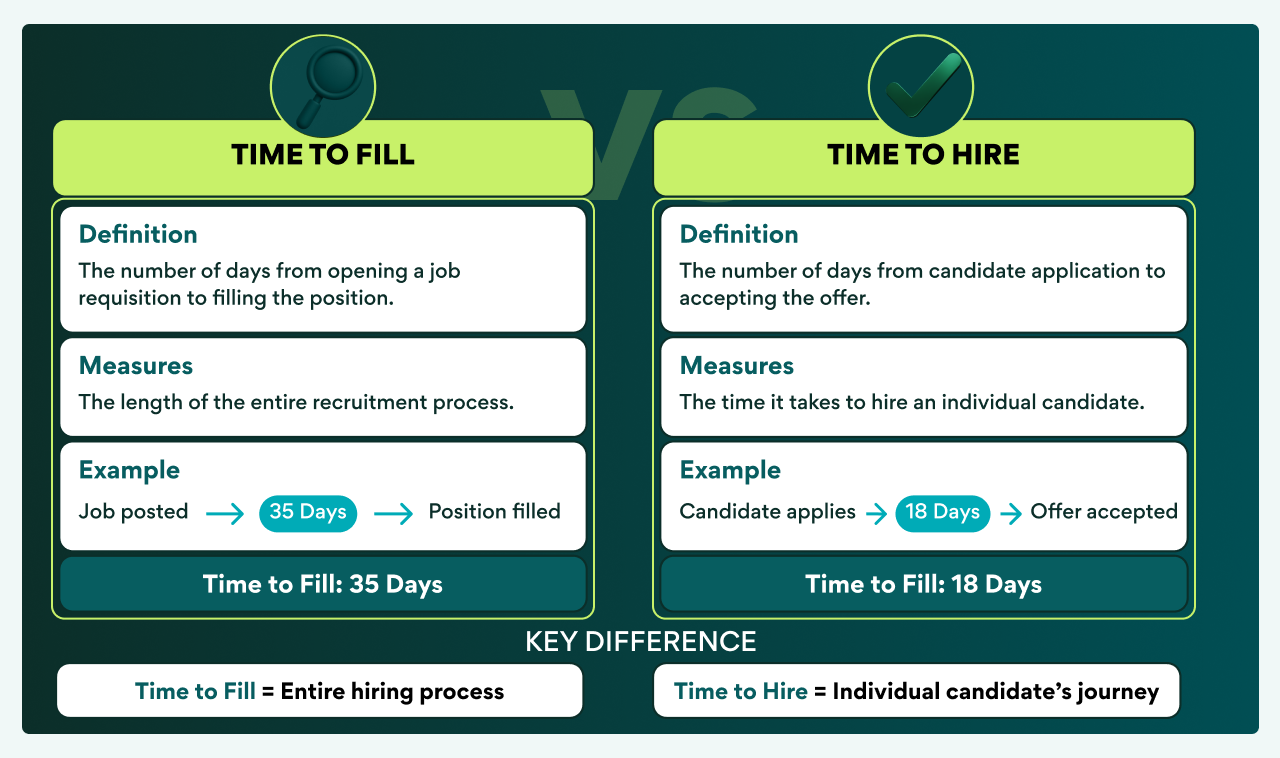
It's worth distinguishing time to hire from a related metric: time to fill. Time to fill starts counting from the day a role is opened, capturing the full recruitment lifecycle including sourcing and early screening. Time to hire, by contrast, focuses on the candidate's journey through your process. Both matter, but time to hire is the sharper signal — it tells you how efficiently your pipeline converts interest into a signed offer.
In tech recruitment specifically, optimizing time to hire is a business imperative. Every week a critical role sits unfilled has a measurable impact on team output and product delivery. The companies that win top developers aren’t always those offering the highest salaries — they’re often the ones that move the fastest.
Every day a developer role sits vacant your team absorbs the cost — missed deadlines, overloaded engineers, and product momentum lost to a hiring process that wasn't built for speed.
The average time to hire a software developer hovers around 45 days. For fast-moving tech companies, that's 45 days of compounding delays. But it doesn't have to be.
Recruiters at ALLSTARSIT have spent years placing developers across high-growth teams, and they've distilled what actually works into a set of tactics that consistently cut time to hire by 40% or more. Here's exactly what they do.
Understanding where time gets lost is the first step to getting it back. In tech recruitment, delays rarely come from a single source — they accumulate across the pipeline, each one adding days that candidates experience as silence, uncertainty, and eventually, disinterest.
When a hiring team hasn't agreed on what "the right candidate" actually looks like, the process stalls before it starts. Vague or bloated job descriptions attract the wrong applicants, misalign recruiter and hiring manager expectations, and lead to endless debates mid-process about whether a candidate is "technical enough" or "the right fit." Clarity at the brief stage saves weeks downstream.
Multi-stage interview processes have become standard in tech, but many companies have let them balloon far beyond what's necessary. Five rounds, six stakeholders, a take-home task plus a live coding session: each step added "just to be sure" extends the timeline and tests a candidate's patience more than their ability. Strong candidates with multiple offers in play frequently withdraw before the last interview round.
One of the most common (and most fixable) bottlenecks is the gap between an interview and the feedback that follows it. When hiring managers take days to debrief, or offer approvals require sign-off from multiple stakeholders with conflicting schedules, candidates go cold. When competition is high, waiting two days to respond can cost you the hire.
When everyone involved in hiring has a different idea of priorities — the engineering lead wants deep system design experience, the CTO cares about culture fit, the product team wants someone who can ship fast — candidates get pulled in different directions and decisions stall. Without a single aligned brief, consensus takes time no one has.
Many companies only start looking for developers when a seat becomes vacant. By then, they're already behind. Building no talent pipeline, maintaining no relationships with passive candidates, and starting every search from scratch adds weeks to every hire before the process has even officially begun.
Technical evaluations are necessary, but poorly designed ones slow everything down. Assessments that are too long, too abstract, or disconnected from the actual role frustrate strong candidates and generate results that are hard to evaluate quickly. When the assessment stage drags, so does everything that follows it.
Every day a developer role sits vacant your team absorbs the cost — missed deadlines, overloaded engineers, and product momentum lost to a hiring process that wasn't built for speed.
The average time to hire a software developer hovers around 45 days. For fast-moving tech companies, that's 45 days of compounding delays. But it doesn't have to be.
Recruiters at ALLSTARSIT have spent years placing developers across high-growth teams, and they've distilled what actually works into a set of tactics that consistently cut time to hire by 40% or more. Here's exactly what they do.
Time to hire measures the number of days from when a candidate enters your pipeline—either by applying or being contacted—to when they accept your offer. It’s one of the most important recruitment metrics, especially in tech, where speed directly impacts your ability to secure top talent.
Unlike many industries, the developer talent market moves fast and runs on scarcity. Skilled engineers are rarely job hunting for long. They're fielding multiple offers, being headhunted constantly, and making decisions quickly. That means the window between "interested candidate" and "lost candidate" is narrow, and a slow hiring process is often all it takes to push them toward a competitor.
It's worth distinguishing time to hire from a related metric: time to fill. Time to fill starts counting from the day a role is opened, capturing the full recruitment lifecycle including sourcing and early screening. Time to hire, by contrast, focuses on the candidate's journey through your process. Both matter, but time to hire is the sharper signal — it tells you how efficiently your pipeline converts interest into a signed offer.
In tech recruitment specifically, optimizing time to hire is a business imperative. Every week a critical role sits unfilled has a measurable impact on team output and product delivery. The companies that win top developers aren’t always those offering the highest salaries — they’re often the ones that move the fastest.
Understanding where time gets lost is the first step to getting it back. In tech recruitment, delays rarely come from a single source — they accumulate across the pipeline, each one adding days that candidates experience as silence, uncertainty, and eventually, disinterest.
When a hiring team hasn't agreed on what "the right candidate" actually looks like, the process stalls before it starts. Vague or bloated job descriptions attract the wrong applicants, misalign recruiter and hiring manager expectations, and lead to endless debates mid-process about whether a candidate is "technical enough" or "the right fit." Clarity at the brief stage saves weeks downstream.
Multi-stage interview processes have become standard in tech, but many companies have let them balloon far beyond what's necessary. Five rounds, six stakeholders, a take-home task plus a live coding session: each step added "just to be sure" extends the timeline and tests a candidate's patience more than their ability. Strong candidates with multiple offers in play frequently withdraw before the last interview round.
One of the most common (and most fixable) bottlenecks is the gap between an interview and the feedback that follows it. When hiring managers take days to debrief, or offer approvals require sign-off from multiple stakeholders with conflicting schedules, candidates go cold. When competition is high, waiting two days to respond can cost you the hire.
When everyone involved in hiring has a different idea of priorities — the engineering lead wants deep system design experience, the CTO cares about culture fit, the product team wants someone who can ship fast — candidates get pulled in different directions and decisions stall. Without a single aligned brief, consensus takes time no one has.
Many companies only start looking for developers when a seat becomes vacant. By then, they're already behind. Building no talent pipeline, maintaining no relationships with passive candidates, and starting every search from scratch adds weeks to every hire before the process has even officially begun.
Technical evaluations are necessary, but poorly designed ones slow everything down. Assessments that are too long, too abstract, or disconnected from the actual role frustrate strong candidates and generate results that are hard to evaluate quickly. When the assessment stage drags, so does everything that follows it.
Cutting time to hire isn't about rushing decisions or lowering the bar. The goal is to remove anything that slows down confident hiring decisions. Here are six proven tactics ALLSTARSIT recruiters use consistently across developer hiring engagements. Together they helped us achieve a 40% reduction in time to hire.
The most expensive delays in hiring don't happen during interviews. They happen in the gaps between them when stakeholders disagree on what they're looking for. Before a single candidate is contacted, bring every decision-maker into a structured alignment session. Define the role's core requirements, agree on what a strong candidate looks like at each stage, and clarify who has final sign-off on the offer.
This single step (often dismissed as overhead) routinely eliminates weeks of back-and-forth mid-process. When everyone is working from the same brief, screening is faster, feedback is consistent, and decisions don't stall waiting for consensus that should have been reached at the start.
Bloated job requirements are one of the quietest killers of hiring speed. When a job description lists fifteen "essential" skills, two things happen: strong candidates self-select out, assuming they won't qualify, and your pipeline fills with applicants your team will spend weeks debating.
Work with hiring managers to separate must-haves from nice-to-haves before sourcing begins. Be ruthless. Identify the three to five technical skills and experience markers that are genuinely non-negotiable for the role and build your screening criteria around those alone. A tighter target profile means faster screening, sharper shortlists, and far fewer mid-process disagreements about whether a candidate "is the right fit."
Not all sourcing channels are equal — and in developer hiring, the difference in speed between them is significant. Generic job boards cast a wide net but return high volumes of unqualified applicants that slow your pipeline down. Specialist tech platforms, developer communities, and direct outreach to passive candidates tend to surface better-matched profiles faster.
More importantly, the fastest hires almost always come from talent that already exists in a pipeline. ALLSTARSIT recruiters maintain continuously updated networks of pre-vetted developers — candidates who have been assessed for technical skills, communication, and availability, and who can be moved to interview stage within days. If your team starts sourcing from scratch every time a role opens, you're adding weeks before the process has even begun.
Every unnecessary stage in your interview process is a place where a strong candidate can (and often will) drop out. Audit your current process and ask a direct question at each step: what decision does this help us make that the other stages don't?
Most developer hiring processes can be streamlined to three focused rounds: an initial screening call, a role-relevant technical assessment, and a final interview with the hiring manager or team lead.
Keep technical assessments short and specific — under two hours, directly tied to the actual work of the role. Set a strict internal SLA: every interviewer submits structured feedback within 24 hours. And where the process allows, run stages in parallel rather than sequentially. Overlapping steps can compress your timeline by a week or more without changing a single hiring decision.
Silence kills pipelines. From a candidate's perspective, a slow or inconsistent communication experience signals disorganization — and in a market where strong developers have multiple options, it's often enough to push them toward a faster-moving competitor.
Define clear communication touchpoints at every stage: how quickly candidates hear back after applying, how soon feedback is shared after interviews, and how the offer process will unfold. Assign clear accountability to prevent anything from being missed. Even a brief message acknowledging a candidate's progress keeps them engaged and reduces drop-off. The companies that move fastest don't just have efficient processes — they make candidates feel like a priority throughout.
One of the most effective ways to reduce time to hire is to increase the size of the market you're hiring from. When companies limit their search to a single city or country, they artificially constrain their pipeline — and in competitive tech hubs, that means longer searches, more competition for the same candidates, and higher drop-off rates.
Global hiring opens the pipeline significantly. With the right recruitment partner, companies can access pre-vetted developer talent across multiple markets, often at comparable or lower cost, without the legal and logistical complexity of international employment slowing things down.
Finding the right developer quickly is exactly the problem ALLSTARSIT was built to solve. With over 20 years in tech recruitment and a continuously growing network of pre-vetted developers across global markets, we don't start your search from scratch. We start it from ahead.
Every developer in our network has already been screened for technical skills, communication, and availability. When you open a role, we match your requirements against a pipeline of qualified candidates we already know delivering a shortlist in days, not weeks. Our recruiters manage the process end to end, keeping candidates warm and decisions moving so nothing stalls and no strong hire slips away to a faster-moving competitor. Companies that partner with ALLSTARSIT consistently reduce time to hire by up to 40%.
Ready to hire faster? Get in touch with our recruitment team today and let's build a process that works at the speed your business demands.
Every day a developer role sits vacant your team absorbs the cost — missed deadlines, overloaded engineers, and product momentum lost to a hiring process that wasn't built for speed.
The average time to hire a software developer hovers around 45 days. For fast-moving tech companies, that's 45 days of compounding delays. But it doesn't have to be.
Recruiters at ALLSTARSIT have spent years placing developers across high-growth teams, and they've distilled what actually works into a set of tactics that consistently cut time to hire by 40% or more. Here's exactly what they do.


%201.webp)
