FinOps — short for Financial Operations — is a cloud financial management practice that brings together engineering, finance, and business teams to make smarter, faster decisions about cloud spending.
The core idea is simple: cloud costs should be understood and owned by the people generating them. Not just the CFO. Not just procurement. The engineers shipping the code.
Think of it less as a cost-cutting exercise and more as a financial feedback loop — one that lets your teams move fast without flying blind on spend.
A note on what FinOps is not: It's not a tool you buy, a team you hire, or a one-time audit. It's an ongoing practice — closer to agile or DevOps in spirit than to a traditional finance process.
Most engineering teams treat cloud costs like a utility bill — pay it, forget it, repeat. That works fine at $10k/month. At $500k/month, it becomes a strategic liability.
FinOps is how leading engineering orgs stop reacting to invoices and start making deliberate decisions about where every dollar goes. Here's the practical guide.
The pressure shows up in five specific ways — each one familiar to any engineering leader who's scaled past the startup phase.
When you add an engineer, you add one salary. When you add a feature, you might add dozens of always-on services, data transfers, storage layers, and third-party API calls — each compounding over time. Without visibility and ownership, spend grows in the background while your team focuses on delivery.
In most engineering orgs, nobody truly owns cloud costs. Finance sees the invoice but not the architecture. Engineers see the architecture but not the invoice. FinOps closes that gap by creating shared accountability (and shared language) across both sides.
How much does it cost to serve one customer? To process one transaction? To run one AI inference? These questions are unanswerable without cost attribution. As you scale, unit economics directly inform pricing, margins, and investment decisions. FinOps makes those numbers visible.
Idle resources. Over-provisioned instances. Forgotten dev environments. Unused reserved capacity. These aren't signs of a careless team — they're the natural byproduct of moving fast. FinOps doesn't eliminate waste by policing engineers. It surfaces it early enough to act.
Post-2022, the era of "growth at all costs" is over. Whether you're pre-IPO, scaling a Series B, or running a public company, cloud efficiency has become a proxy for operational maturity. CTOs who can speak fluently about their infrastructure unit economics earn credibility in the boardroom — not just the architecture review.
Most engineering teams treat cloud costs like a utility bill — pay it, forget it, repeat. That works fine at $10k/month. At $500k/month, it becomes a strategic liability.
FinOps is how leading engineering orgs stop reacting to invoices and start making deliberate decisions about where every dollar goes. Here's the practical guide.
FinOps — short for Financial Operations — is a cloud financial management practice that brings together engineering, finance, and business teams to make smarter, faster decisions about cloud spending.
The core idea is simple: cloud costs should be understood and owned by the people generating them. Not just the CFO. Not just procurement. The engineers shipping the code.
Think of it less as a cost-cutting exercise and more as a financial feedback loop — one that lets your teams move fast without flying blind on spend.
A note on what FinOps is not: It's not a tool you buy, a team you hire, or a one-time audit. It's an ongoing practice — closer to agile or DevOps in spirit than to a traditional finance process.
The pressure shows up in five specific ways — each one familiar to any engineering leader who's scaled past the startup phase.
When you add an engineer, you add one salary. When you add a feature, you might add dozens of always-on services, data transfers, storage layers, and third-party API calls — each compounding over time. Without visibility and ownership, spend grows in the background while your team focuses on delivery.
In most engineering orgs, nobody truly owns cloud costs. Finance sees the invoice but not the architecture. Engineers see the architecture but not the invoice. FinOps closes that gap by creating shared accountability (and shared language) across both sides.
How much does it cost to serve one customer? To process one transaction? To run one AI inference? These questions are unanswerable without cost attribution. As you scale, unit economics directly inform pricing, margins, and investment decisions. FinOps makes those numbers visible.
Idle resources. Over-provisioned instances. Forgotten dev environments. Unused reserved capacity. These aren't signs of a careless team — they're the natural byproduct of moving fast. FinOps doesn't eliminate waste by policing engineers. It surfaces it early enough to act.
Post-2022, the era of "growth at all costs" is over. Whether you're pre-IPO, scaling a Series B, or running a public company, cloud efficiency has become a proxy for operational maturity. CTOs who can speak fluently about their infrastructure unit economics earn credibility in the boardroom — not just the architecture review.
FinOps isn't a linear project — it's a continuous cycle. Formally defined by the FinOps Foundation, FinOps is built around three iterating phases:
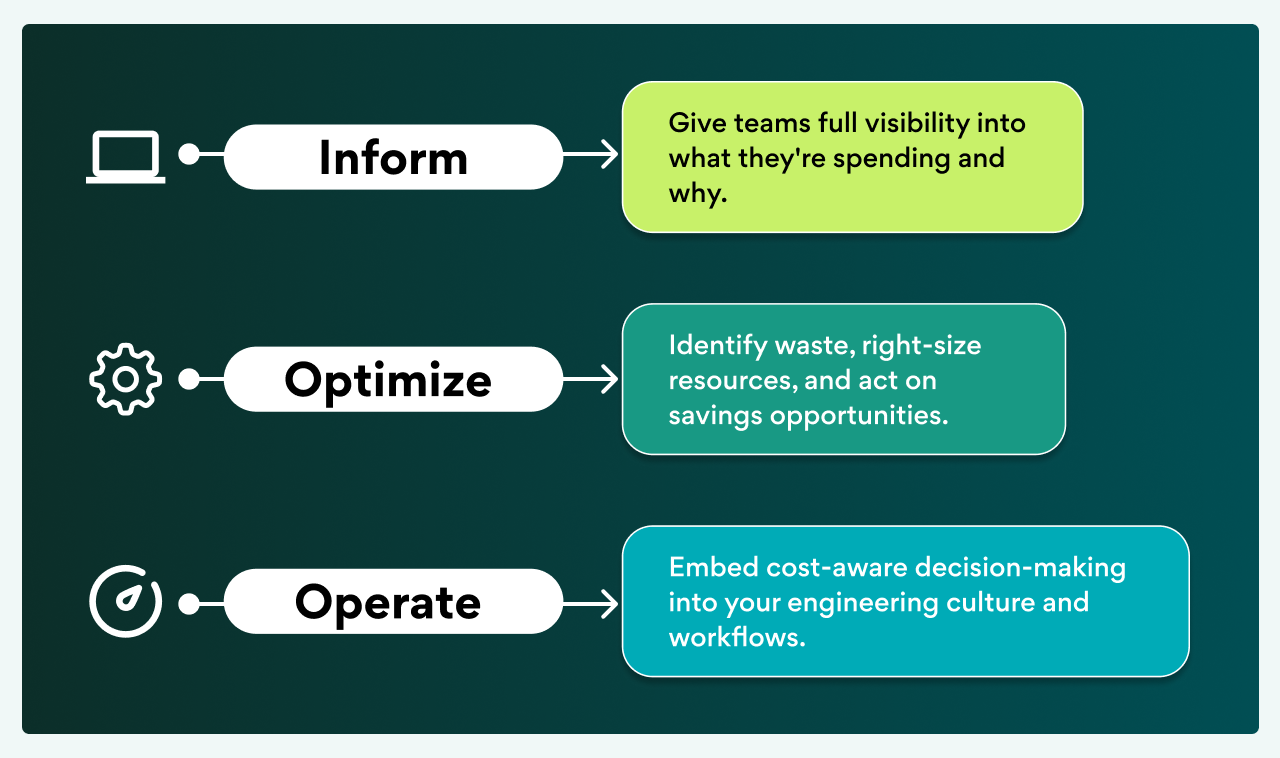
You can't manage what you can't see. The first step is tagging and attribution: making sure every cloud resource is labeled by team, product, environment, or cost center. This sounds simple. In practice, it requires cross-team alignment and often surfaces years of accumulated technical debt in your infrastructure.
Key outputs of this phase:
Once you have visibility, patterns emerge fast. Idle resources. Oversized instances. Services running in production configurations in dev environments. Reserved capacity that was never fully utilized.
Optimization isn't about telling engineers to spend less — it's about giving them the data to make better decisions in the moment. Rightsizing recommendations, commitment-based discounts (reserved instances, savings plans), and automated shutdowns for non-production environments are typically where teams find the fastest wins.
This is the hardest phase, and the most valuable. Operate means cost decisions happen continuously — in sprint planning, architecture reviews, and service design — not just in monthly finance reviews.
Teams in the Operate phase typically have:
FinOps works best as a cross-functional practice, not a siloed team. In most scaling orgs, it looks something like this:
In smaller orgs, a single cloud cost champion — often a senior engineer or platform lead — can carry the FinOps function until dedicated headcount makes sense.
FinOps is what makes engineering speed sustainable at scale.
The companies getting this right treat cloud cost as an engineering concern — one that belongs in architecture decisions, sprint planning, and team-level accountability. The CTO's role is to build the visibility and culture that make cost-aware engineering the default, and it starts smaller than most leaders expect. A tagging standard. A shared dashboard. One team with a budget and the data to manage it. The practice builds from there.
The teams that invest in FinOps early develop a clearer picture of what their infrastructure is actually producing — per customer, per feature, per dollar. That clarity pays off in product decisions, investor conversations, and every architectural choice you make at the next order of magnitude.
Cloud costs grow with you. With the right discipline in place, so does your ability to manage them.
Most engineering teams treat cloud costs like a utility bill — pay it, forget it, repeat. That works fine at $10k/month. At $500k/month, it becomes a strategic liability.
FinOps is how leading engineering orgs stop reacting to invoices and start making deliberate decisions about where every dollar goes. Here's the practical guide.