
Burnout develops when demands consistently exceed available psychological resources. In tech, this usually means:
Burnout is physiologically expensive. People feel tired, irritable, emotionally drained. They often know something is wrong.
Boreout works differently.
Boreout emerges when a capable professional spends years inside the same cognitive territory. The workload may be reasonable. The environment may be stable. The compensation may be competitive.
What is missing is developmental tension.
One engineer described it simply:
“I don’t struggle anymore. I also don’t grow.”
In today’s discussions about employee well-being, burnout is almost a reflex diagnosis. Someone loses motivation — burnout. Someone disengages — burnout again.
From my psychological practice within IT teams, I can say this: burnout exists, but it is often overdiagnosed. A different phenomenon quietly shapes the emotional landscape of long-term tech projects — boreout.
This article is based on real consultations with software engineers, testers, analysts, and tech leads working in stable projects over several years. Many of them perform well. Many of them are not exhausted. Yet something essential slowly fades.
From a business perspective, stability is success.
From a psychological perspective, unchanging complexity over long periods is risky.
In my practice, boreout most often appears when:
People in these roles are often reliable performers. They know the system deeply. They are valuable.
And yet, internally, motivation slowly shifts from interest to routine.
Neuroscience explains this well: motivation is tightly linked to learning signals. When learning is left on hold for too long, engagement weakens — even if conditions are comfortable.
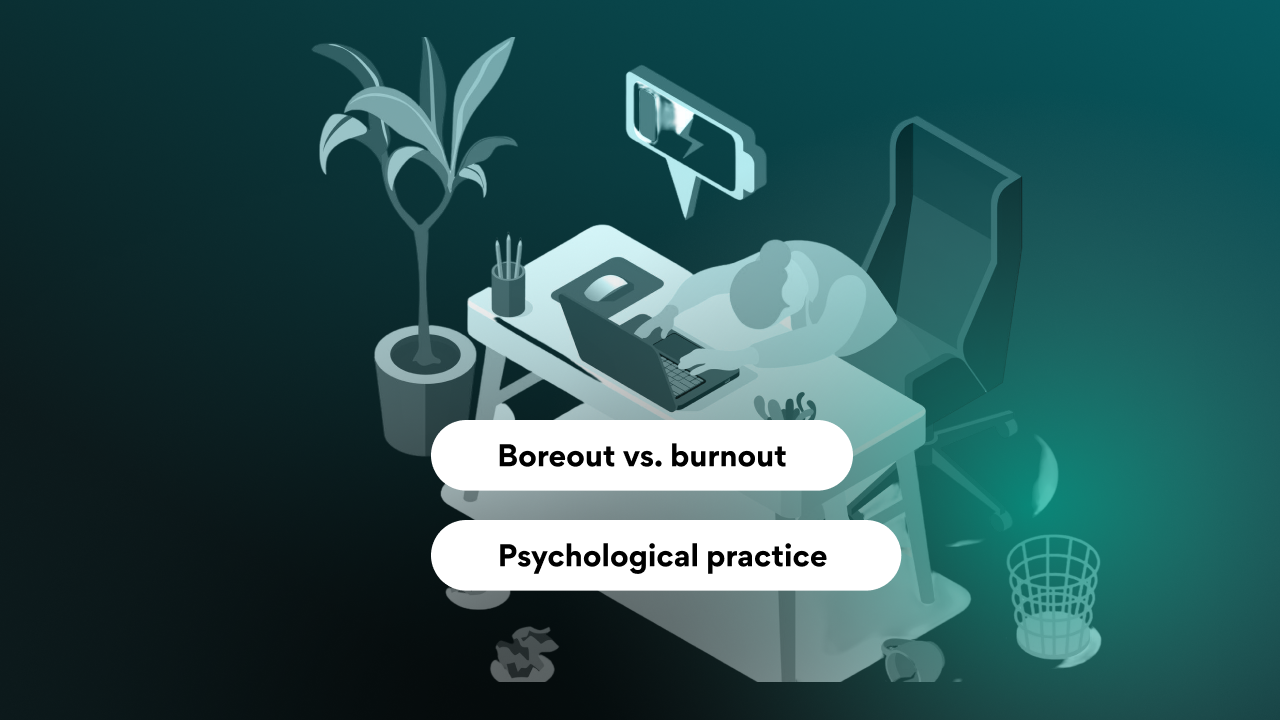
In today’s discussions about employee well-being, burnout is almost a reflex diagnosis. Someone loses motivation — burnout. Someone disengages — burnout again.
From my psychological practice within IT teams, I can say this: burnout exists, but it is often overdiagnosed. A different phenomenon quietly shapes the emotional landscape of long-term tech projects — boreout.
This article is based on real consultations with software engineers, testers, analysts, and tech leads working in stable projects over several years. Many of them perform well. Many of them are not exhausted. Yet something essential slowly fades.
Burnout develops when demands consistently exceed available psychological resources. In tech, this usually means:
Burnout is physiologically expensive. People feel tired, irritable, emotionally drained. They often know something is wrong.
Boreout works differently.
Boreout emerges when a capable professional spends years inside the same cognitive territory. The workload may be reasonable. The environment may be stable. The compensation may be competitive.
What is missing is developmental tension.
One engineer described it simply:
“I don’t struggle anymore. I also don’t grow.”
From a business perspective, stability is success.
From a psychological perspective, unchanging complexity over long periods is risky.
In my practice, boreout most often appears when:
People in these roles are often reliable performers. They know the system deeply. They are valuable.
And yet, internally, motivation slowly shifts from interest to routine.
Neuroscience explains this well: motivation is tightly linked to learning signals. When learning is left on hold for too long, engagement weakens — even if conditions are comfortable.
Boreout does not feel dramatic. There is no crisis moment.
People say:
“The project is fine.”
“Others would be happy here.”
“I can’t really complain.”
So they don't identify it.
Instead, boreout shows up indirectly:
One specialist told me: “I feel like my skills are slowly fossilizing.” This is not a performance issue. It is a meaning and growth issue.
Externally, both states may look similar: reduced engagement, emotional distance, lower enthusiasm. Internally, they are opposites:
This distinction matters in practice.
I’ve seen bored engineers sent on forced “rest” — which increased emptiness.
I’ve seen burned-out engineers given “new exciting challenges” — which accelerated exhaustion.
This tactical inaccuracy directly affects the results.
Based on my practice, I can tell that boreout is rarely solved by:
What helps is qualitative change:
Often, horizontal development is more effective than vertical promotion. People don’t always need a new title. They need new cognitive territory.
Boreout is not an individual failure. This is a signal for management.
When a company works with long-term projects, it faces a specific psychological responsibility: not only to maintain delivery quality, but to maintain learning dynamics.
When teams normalize conversations about stagnation instead of interpreting them as disloyalty, retention improves naturally — not because people are forced to stay, but because staying makes psychological sense.
The most revealing sentence I hear is not emotional or dramatic. It is quiet: “I don’t feel that I’m growing anymore.”
This sentence does not describe a weak specialist. It describes a system that has stopped challenging a strong one.
Burnout and boreout are not buzzwords. They are signals of mismatch between work structure and human psychology. Tech evolves fast. When people don’t, the cost is paid later.
In today’s discussions about employee well-being, burnout is almost a reflex diagnosis. Someone loses motivation — burnout. Someone disengages — burnout again.
From my psychological practice within IT teams, I can say this: burnout exists, but it is often overdiagnosed. A different phenomenon quietly shapes the emotional landscape of long-term tech projects — boreout.
This article is based on real consultations with software engineers, testers, analysts, and tech leads working in stable projects over several years. Many of them perform well. Many of them are not exhausted. Yet something essential slowly fades.


%201.webp)
