
Before building or scaling an offshore R&D team, it’s critical to understand the different engagement models available.
The most common model is outsourcing, where development is handled by a third-party vendor responsible for delivery. This approach works well for clearly defined, short-term projects but may limit transparency and ownership. You gain speed, but usually at the cost of deep product knowledge and strategic alignment.
A dedicated offshore team sits between outsourcing and full ownership. Engineers are allocated exclusively to your company while operational support (HR, office, payroll) is handled by a partner. This model offers better continuity, stronger team identity, and more control over processes. All these benefits make it a popular choice for growing product companies.
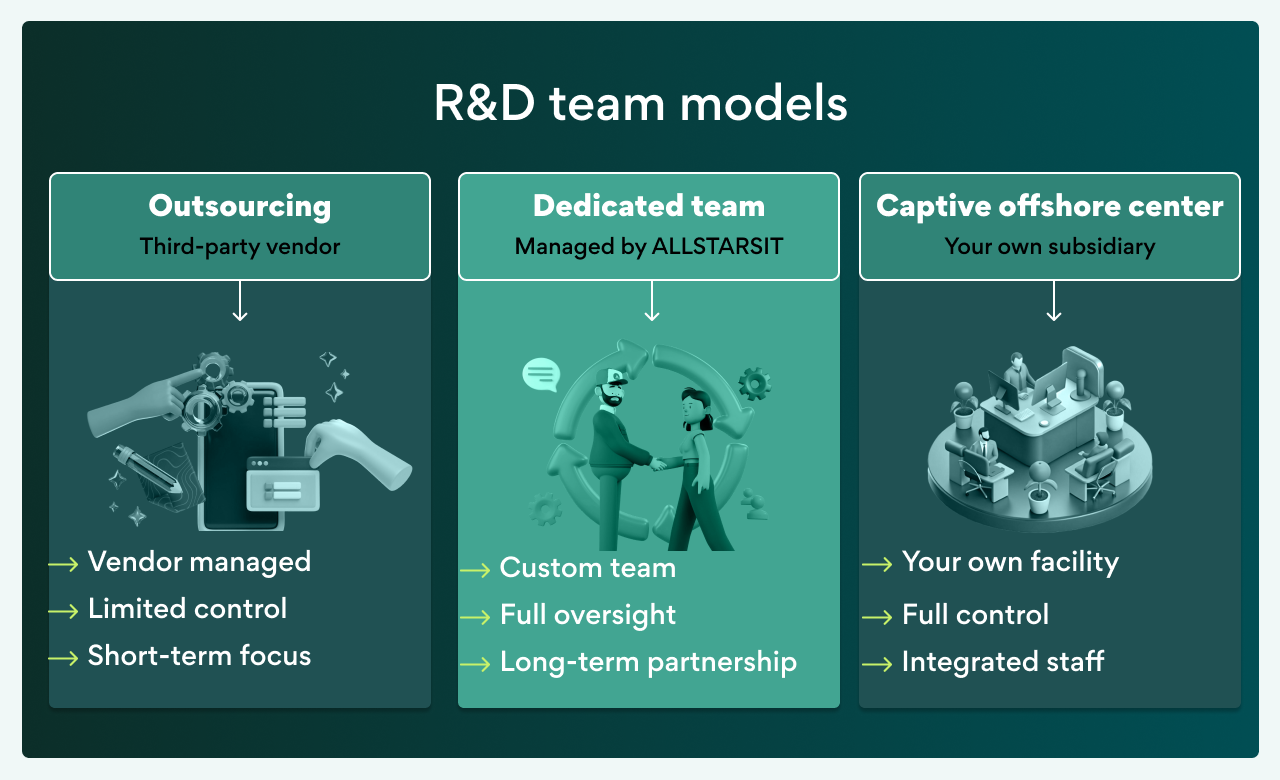
Finally, a captive offshore center (your own legal entity abroad) provides maximum control, cultural alignment, and IP security. It’s best suited for mature organizations with long-term R&D needs, but it requires higher upfront investment and management capacity.
The right model depends on your product maturity, budget, internal leadership bandwidth, and long-term goals. Treat this decision as a strategic foundation because everything else in offshore R&D management builds on it.
Offshore R&D teams offer access to global talent, faster scaling, and significant cost advantages, but only if they’re managed well. In this article, we’ll cover proven best practices for managing offshore R&D teams effectively, so you can build a high-performing extension of your core engineering organization.
Clear goals are the backbone of a successful offshore R&D team. Start by aligning the offshore team’s objectives with your broader product and business goals. This includes ownership over specific features, components, or outcomes (not just tickets or hours logged). Clear responsibility drives accountability and better decision-making.
Equally important is defining measurable success metrics. These can include delivery predictability, code quality indicators, cycle time, defect rates, and customer-impact metrics tied to product performance. Avoid overloading teams with KPIs; focus on a small set that reflects both speed and quality.
Finally, review goals and metrics regularly. As products evolve, offshore R&D goals should adapt alongside them. Continuous alignment ensures the team remains focused and fully integrated into your company’s long-term success.
Offshore R&D teams offer access to global talent, faster scaling, and significant cost advantages, but only if they’re managed well. In this article, we’ll cover proven best practices for managing offshore R&D teams effectively, so you can build a high-performing extension of your core engineering organization.
Before building or scaling an offshore R&D team, it’s critical to understand the different engagement models available.
The most common model is outsourcing, where development is handled by a third-party vendor responsible for delivery. This approach works well for clearly defined, short-term projects but may limit transparency and ownership. You gain speed, but usually at the cost of deep product knowledge and strategic alignment.
A dedicated offshore team sits between outsourcing and full ownership. Engineers are allocated exclusively to your company while operational support (HR, office, payroll) is handled by a partner. This model offers better continuity, stronger team identity, and more control over processes. All these benefits make it a popular choice for growing product companies.
Finally, a captive offshore center (your own legal entity abroad) provides maximum control, cultural alignment, and IP security. It’s best suited for mature organizations with long-term R&D needs, but it requires higher upfront investment and management capacity.
The right model depends on your product maturity, budget, internal leadership bandwidth, and long-term goals. Treat this decision as a strategic foundation because everything else in offshore R&D management builds on it.
Clear goals are the backbone of a successful offshore R&D team. Start by aligning the offshore team’s objectives with your broader product and business goals. This includes ownership over specific features, components, or outcomes (not just tickets or hours logged). Clear responsibility drives accountability and better decision-making.
Equally important is defining measurable success metrics. These can include delivery predictability, code quality indicators, cycle time, defect rates, and customer-impact metrics tied to product performance. Avoid overloading teams with KPIs; focus on a small set that reflects both speed and quality.
Finally, review goals and metrics regularly. As products evolve, offshore R&D goals should adapt alongside them. Continuous alignment ensures the team remains focused and fully integrated into your company’s long-term success.
A strong team structure turns an offshore R&D team from a support function into a true extension of your engineering organization. Poorly defined roles and reporting lines often lead to confusion, slow decision-making, and duplicated work.
Start by organizing offshore teams around product ownership, not just technical skills. Cross-functional squads with clear ownership over features or services tend to perform better than loosely connected specialists. Each team should have defined roles—such as tech lead, product owner, and QA, so responsibilities are clear and decisions don’t stall.
Local leadership is critical. Appointing an offshore engineering lead or manager helps bridge cultural and time-zone gaps, ensures day-to-day execution, and reduces dependency on onshore managers. This role acts as both a technical authority and a people leader.
Finally, integrate offshore teams into your existing org structure rather than treating them as a separate unit. Shared standards, consistent career paths, and unified reporting lines foster accountability and alignment.
Time zone differences can either slow teams down or become a competitive advantage when managed well. The key is designing communication intentionally, rather than relying on ad-hoc meetings and real-time availability.
Start by embracing asynchronous communication. Clear documentation, written updates, and well-defined handoff processes reduce dependency on overlapping work hours. Tools like shared backlogs, design docs, and decision logs help everyone stay aligned without constant meetings.
When real-time collaboration is necessary, protect overlapping hours. Schedule recurring syncs during mutually reasonable times and keep them focused and agenda-driven. Consistency matters more than frequency.
Equally important is clarity. Define communication norms around response times, escalation paths, and decision ownership. When offshore teams know where to ask questions and how decisions are made, work moves faster even across continents.
Start by standardizing how work moves from idea to production. Agile practices such as well-defined sprint planning, clear acceptance criteria, and regular retrospectives help offshore teams stay aligned with priorities and timelines. Consistency across onshore and offshore teams is key, as different rules create friction.
Code reviews, documentation standards, and clear definition-of-done criteria ensure shared expectations around quality. Automated tooling for CI/CD, testing, and deployments further reduces dependency on individual contributors and minimizes errors.
Finally, treat processes as living systems. Regularly review what’s working, gather feedback from offshore engineers, and refine workflows as the team and product evolve. Well-designed processes create autonomy (not bureaucracy).
Effective knowledge transfer is critical to the long-term success of offshore R&D teams. Without it, teams become dependent on a few individuals, onboarding drags on, and productivity suffers.
Start by documenting core product knowledge, architecture decisions, and development standards in a centralized, easily accessible format. Written knowledge scales far better than verbal explanations (especially across time zones). Design docs, runbooks, and recorded walkthroughs are invaluable.
Onboarding should be structured, not improvised. Define clear onboarding plans with milestones for the first weeks and months, pairing new offshore engineers with mentors who can guide them through both technical and organizational context.
Finally, make knowledge sharing continuous. Regular demos, retrospectives, and cross-team sessions help reinforce learning and prevent silos. When knowledge flows freely, offshore teams ramp up faster and operate with greater independence.
Trust is the foundation of any successful offshore R&D team. Without it, collaboration breaks down, communication becomes guarded, and teams revert to micromanagement instead of ownership.
Start by treating offshore engineers as equal partners, not external resources. Include them in planning, decision-making, and product discussions so they understand context and feel accountable for outcomes. Transparency builds confidence on both sides.
Consistent feedback and recognition also play a major role. Regular one-on-ones, clear growth paths, and acknowledgment of achievements help create psychological safety and long-term engagement.
Finally, invest in human connection. Shared rituals, virtual team events, and occasional in-person meetings go a long way in building rapport. A strong team culture bridges distance, aligns values, and turns distributed teams into a cohesive unit.
ALLSTARSIT provides end-to-end R&D services that help companies build, scale, and manage high-performing offshore engineering teams with speed and confidence. We handle talent acquisition, team setup, and operational support, so you get a fully integrated R&D extension aligned with your product goals without the overhead of managing it yourself.
Fill out the form to discuss your needs and see how we can help you scale your R&D faster and more efficiently.
Offshore R&D teams offer access to global talent, faster scaling, and significant cost advantages, but only if they’re managed well. In this article, we’ll cover proven best practices for managing offshore R&D teams effectively, so you can build a high-performing extension of your core engineering organization.


