An offshore development center (ODC) is a dedicated, long-term software development team located in a different country that functions as an extension of your in-house engineering department. Unlike traditional outsourcing, where you hand off isolated tasks or short-term projects, an ODC operates as a strategic, full-time remote unit aligned with your company’s goals and processes.
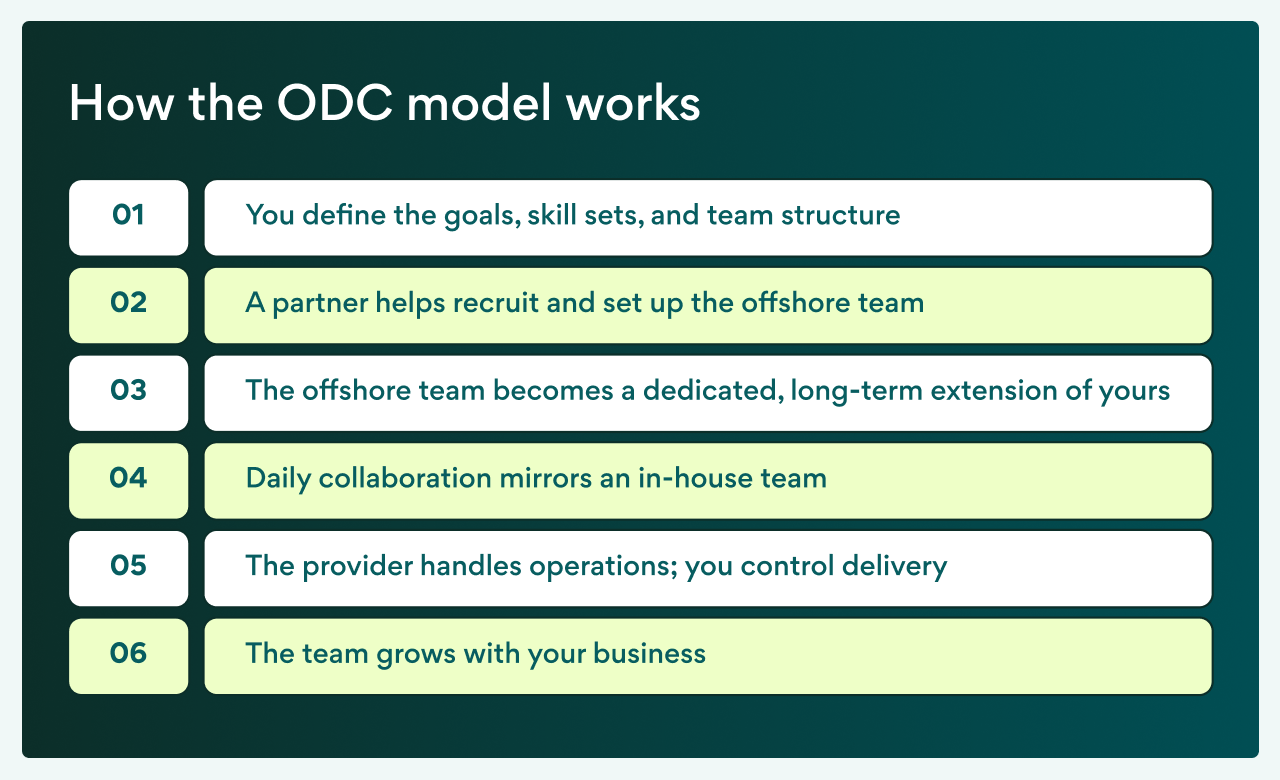
An ODC typically includes developers, QA engineers, DevOps specialists, designers, and project managers who work exclusively for you, following your workflows, tools, and quality standards. Many companies choose this model to access global talent, scale faster, reduce costs, and maintain tighter control over product development than traditional outsourcing allows.
As tech companies race to innovate, many are discovering that traditional hiring models can’t keep up with their growth needs. That’s where the offshore development center (ODC) model comes in. More than a cost-saving tactic, an ODC gives you a dedicated, long-term extension of your in-house team, designed to accelerate product delivery while maintaining full control and quality. In this guide, we’ll break down how the model works, why it’s gaining momentum, and what it can mean for your engineering strategy in 2026 and beyond.
Choosing between an offshore development center (ODC) and traditional outsourcing comes down to how much control, stability, and long-term value you want from your development team. Here’s a side-by-side look at the key differences:
As tech companies race to innovate, many are discovering that traditional hiring models can’t keep up with their growth needs. That’s where the offshore development center (ODC) model comes in. More than a cost-saving tactic, an ODC gives you a dedicated, long-term extension of your in-house team, designed to accelerate product delivery while maintaining full control and quality. In this guide, we’ll break down how the model works, why it’s gaining momentum, and what it can mean for your engineering strategy in 2026 and beyond.
An offshore development center (ODC) is a dedicated, long-term software development team located in a different country that functions as an extension of your in-house engineering department. Unlike traditional outsourcing, where you hand off isolated tasks or short-term projects, an ODC operates as a strategic, full-time remote unit aligned with your company’s goals and processes.
An ODC typically includes developers, QA engineers, DevOps specialists, designers, and project managers who work exclusively for you, following your workflows, tools, and quality standards. Many companies choose this model to access global talent, scale faster, reduce costs, and maintain tighter control over product development than traditional outsourcing allows.
Choosing between an offshore development center (ODC) and traditional outsourcing comes down to how much control, stability, and long-term value you want from your development team. Here’s a side-by-side look at the key differences:
The offshore development center model isn’t just for tech giants. It’s a scalable, strategic option that benefits companies at various stages of growth. Here’s who gains the most from building an ODC.
Startups often struggle to hire experienced engineers fast enough in competitive local markets. An ODC provides immediate access to a larger talent pool, allowing them to build features faster, expand product lines, and accelerate time-to-market without overstretching budgets.
If your business relies on continuous product evolution (new releases, refactoring, feature expansion) an ODC’s dedicated, stable structure helps ensure knowledge retention, consistent code quality, and smooth long-term iteration.
Large organizations often face high overhead and salary costs. An ODC gives them the ability to reduce expenses while maintaining control and technical direction over their development processes.
In many regions, finding senior developers, DevOps engineers, or data specialists can be slow or nearly impossible. ODCs tap into global tech hubs where these skills are more available, reducing hiring cycles from months to weeks.
Because ODC teams work exclusively for you, with clear legal frameworks and strong governance, they’re ideal for companies that need secure, long-term engineering support for core products, proprietary algorithms, or sensitive architecture.
Building an ODC in a strategic region can support global growth, improve customer coverage across time zones, and strengthen your presence in new markets.
When you’re ready to build an offshore development center, you generally have two paths: setting everything up on your own or partnering with a specialized provider such as ALLSTARSIT. Both approaches can lead to a high-performing offshore team, but they differ significantly in complexity, speed, and risk.
Setting up an ODC on your own gives you complete ownership of the entire operation. You choose the country, register a legal entity, manage recruitment, negotiate office space, set up IT infrastructure, and handle local HR, payroll, and compliance. This approach can offer maximum control, but it also requires deep knowledge of the local market, a strong network, and substantial upfront investment. It’s best suited for large companies that have the time, budget, and internal expertise to build a remote engineering center from the ground up.
The other option is working with a dedicated ODC partner like ALLSTARSIT. Instead of building everything yourself, you tap into an existing operational framework that’s already optimized for hiring, onboarding, retention, and compliance. The provider handles the logistics (recruitment pipelines, HR, IT setup, workspace, contracts, and legal safeguards) while you maintain full control over the engineering team’s priorities, culture, and delivery standards. This route dramatically reduces risk, speeds up setup time, and allows you to start building your team within weeks rather than years.
In essence, building an ODC independently offers autonomy but demands significant effort and expertise, while partnering with a company like ALLSTARSIT delivers a ready-made foundation that lets you focus entirely on product development rather than operations. Both approaches can work—the right choice depends on how quickly you need to scale, how much risk you’re willing to take on, and how involved you want to be in managing overseas operations.
The cost structure of an offshore development center is one of its biggest advantages. While exact numbers vary by location and team composition, ODC costs generally fall into a few well-defined categories that make budgeting straightforward.
The largest portion of the cost typically goes toward salaries for engineers, QA specialists, DevOps, designers, and other team members. Because ODCs operate in talent-rich regions with lower labor costs, companies can access senior-level expertise at a significantly reduced rate compared to hiring locally. These salaries are usually billed at cost, with no hidden markups, which gives you a clear view of where your budget is going.
In addition to salaries, there’s an operational fee that covers all the behind-the-scenes essentials needed to run a productive offshore center. This can include HR support, recruitment, workspace (if not remote), IT infrastructure, hardware, software licenses, benefits, team events, and ongoing employee management. When working with an ODC partner, this fee also includes administrative services such as payroll, legal compliance, tax handling, and local employment obligations removing the burden from your internal teams.
Some companies may also allocate funds for onboarding trips, occasional in-person meetings, or specialized training to fully integrate the offshore team with the in-house organization. While optional, these investments often strengthen collaboration and alignment across teams.
Overall, the ODC model offers a highly transparent and predictable cost structure: you pay for your team’s actual compensation plus a clear operational fee, without the unpredictable overages or hourly fluctuations common in outsourcing. This makes long-term planning easier and gives companies far more control over both budget and output. Let me know if you’d like a sample cost breakdown table or region-specific comparisons.
Choosing the right location is a crucial part of building an effective offshore development center. While talent exists worldwide, a few regions consistently stand out for their engineering expertise, cost efficiency, cultural compatibility, and mature tech ecosystems. Here are the global hotspots companies most often consider when setting up an ODC.
India remains one of the most popular destinations for offshore development centers. With millions of tech professionals, strong English proficiency, and decades of experience working with global companies, India offers a deep talent pool across nearly every tech stack. The country is known for competitive costs, rapid hiring capabilities, and well-established IT infrastructure, making it ideal for large-scale engineering teams.
Eastern Europe is a top choice for companies that prioritize advanced technical expertise, strong engineering culture, and minimal time-zone differences with Europe. Countries like Ukraine and Poland are known for highly skilled developers, especially in complex fields such as cybersecurity, product engineering, and enterprise software. The region also offers strong cultural compatibility and excellent communication skills.
Latin America has grown rapidly as a nearshore option for North American companies. With overlapping time zones and strong English proficiency in major tech hubs, LATAM is ideal for companies that want real-time collaboration without sacrificing cost advantages. The region is especially attractive for Agile development, support teams, and long-term product engineering.
Southeast Asia offers a blend of affordability, fast-growing tech ecosystems, and young engineering talent. Vietnam, in particular, has become a standout for software development, known for strong STEM education and increasing specialization in mobile and web development. The Philippines excels in communication-heavy roles and hybrid tech-support functions due to high English proficiency.
The offshore development center model has evolved far beyond its early perception as a cost-saving tactic. Today, it’s a strategic way for companies to access global talent, accelerate development, and build long-term engineering capacity without the constraints of local hiring. Whether you choose to establish an ODC independently or partner with an experienced provider, the model offers the flexibility, control, and scalability modern product teams need to stay competitive.
As remote collaboration becomes the norm and global talent markets continue to mature, ODCs are positioned to play an even bigger role in how companies build and innovate. With the right structure, the right partner, and the right mindset, an offshore development center can become one of your most powerful assets for long-term growth and product success.
If you’re looking to scale your engineering team, reduce operational overhead, and accelerate product delivery, an offshore development center might be the most strategic move you can make. ALLSTARSIT can help you set it up quickly, securely, and with the right talent from day one. Let’s talk.
As tech companies race to innovate, many are discovering that traditional hiring models can’t keep up with their growth needs. That’s where the offshore development center (ODC) model comes in. More than a cost-saving tactic, an ODC gives you a dedicated, long-term extension of your in-house team, designed to accelerate product delivery while maintaining full control and quality. In this guide, we’ll break down how the model works, why it’s gaining momentum, and what it can mean for your engineering strategy in 2026 and beyond.